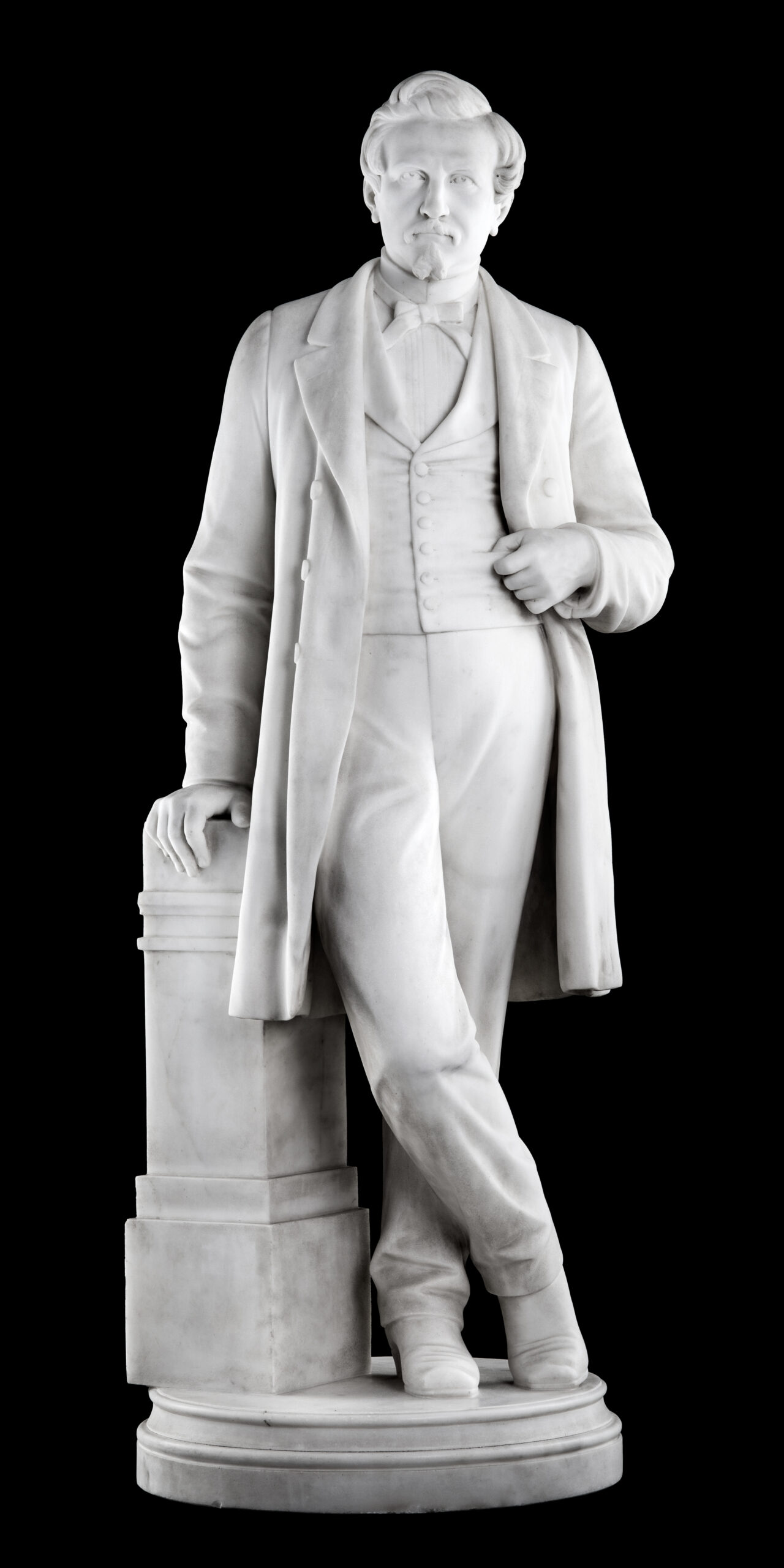
guillaume geefs · (1805–1883)
Portrait of a standing gentleman
technical sheet
| ARTIST | Guillaume (Willem) Geefs |
| DATE | 1873 |
| material | White Carrara marble • original wooden column |
| DIMENSIONS | 111 x 45 x 38,5 cm |
| Signature | Gme Geefs statuaire du Roi 1873 |
| PROVENANCE | |
| CONSERVATION | Private Collection • Belgium |
about the work
This portrait, possibly of the artist’s brother the painter Joseph Geefs, represents a fully self-possessed man posing frontally. He is not known by name, yet he has the air of one who has succeeded in life: calm, restrained and satisfied. The sculptor drew that psychological dimension from the precious marble in part through the naturalism he lent to the position of the legs and feet.
What apparent self-evidence Geefs also invested in the clothing! The loosely draped mantle is an artwork in itself; the sleeves, trousers and vest appear to have nothing at all to do with marble.
The square, solid plinth exceeds the round base, and the man, looking in our direction, is somewhat turned to the left, a device used to keep the work from appearing too conventional. The whole rests upon its original wooden column.

Undoubtedly the most famous of the nineteenth-century Belgian sculptors, Guillaume Geefs was the eldest of seven brothers who all devoted themselves to sculpture. Sobriety, elegance and technical ability typify his voluminous oeuvre, which includes classicist sculptures, statues, funerary monuments, religious works and countless portraits.
An academy student in Antwerp and later, in Paris, a pupil of J.E. Ramey, he won national fame through the statue of Belliard, the grave of Frédéric de Mérode and the memorial to the fallen of the September days. A gifted portraitist, he earned the title of Royal Sculptor to the Court and received the most varied commissions, including foreign ones. Marble was his favourite material.