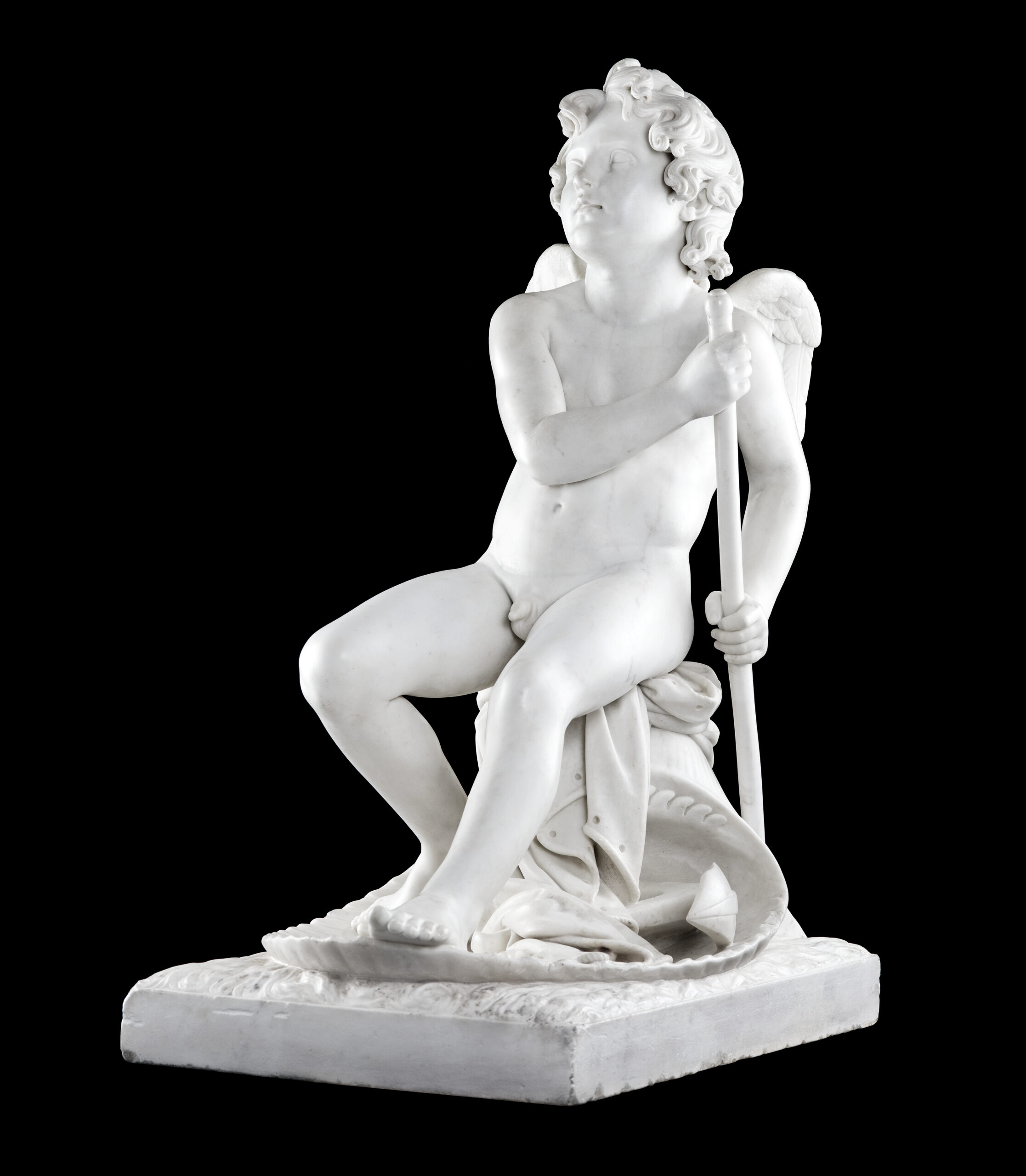
jean-baptiste joseph de bay · (1802–1862)
The Spirit of Seafaring
Technical sheet
| ARTIST | Jean-Baptiste Joseph De Bay (known as Jean De Bay) |
| DATE | 1832 • executed in Rome |
| material | White Carrara marble |
| DIMENSIONS | 101 x 48 x 85 cm |
| Signature | JEAN DEBAY |
| PROVENANCE | Rome, 1832 • Paris, exhibition at the Petits-Augustins, June 1832 • Paris Salon, 1833 (no. 2509) • Collection of Mr Hoppe, Amsterdam, 1833 • Private collection, 1833-2010 |
| CONSERVATION | Private Collection • Italy |
About the work
An allegory of the sea, this sculpture depicts a Cupid braving the current aboard a small shell-shaped boat. He steers with an oar, seated on a folded sail beside an anchor. Cupid’s determination to hold his own course and pace, never wishing to stop, may allude to the persistence of love against all odds.
Carved in marble and presented in Rome in 1832, the work was sent to Paris on 15 June of the same year to be exhibited, still unfinished, at the Petits-Augustins. Once completed, it appeared at the 1833 Paris Salon under number 2509, where it was acquired by the Amsterdam banker Mr Hoppe.
Through the refinement of its execution and the elegance of its composition, The Spirit of Seafaring bears witness to De Bay’s art, between classical tradition and Romantic sensibility, as it flourished during his stay in Rome.
the ARTIST
Jean-baptiste joseph de bay
Nantes, 1802 — 1862, Paris
Known as Jean De Bay, like his father, also a sculptor, he was born in Nantes on 31 August 1802. A pupil of his father and of Baron Bosio, he entered the École des Beaux-Arts in 1820. After winning all its medals there, he took the second Grand Prix for sculpture in 1823, then the first Grand Prix in 1829 with The Death of Hyacinth.
Back from Rome, he regularly sent numerous works to the Salon and worked for the Louvre, the Hôtel de Ville and the churches of La Madeleine and Saint-Eustache. He is the author of the statues of General Cambronne and Marshal Oudinot. Made a Knight of the Legion of Honour in 1851, he died in Paris on 7 January 1862, leaving some sculptures that were completed by his brother Auguste De Bay. Several of his works are held at the Louvre and at Versailles.