charles van der stappen · (1843–1910)
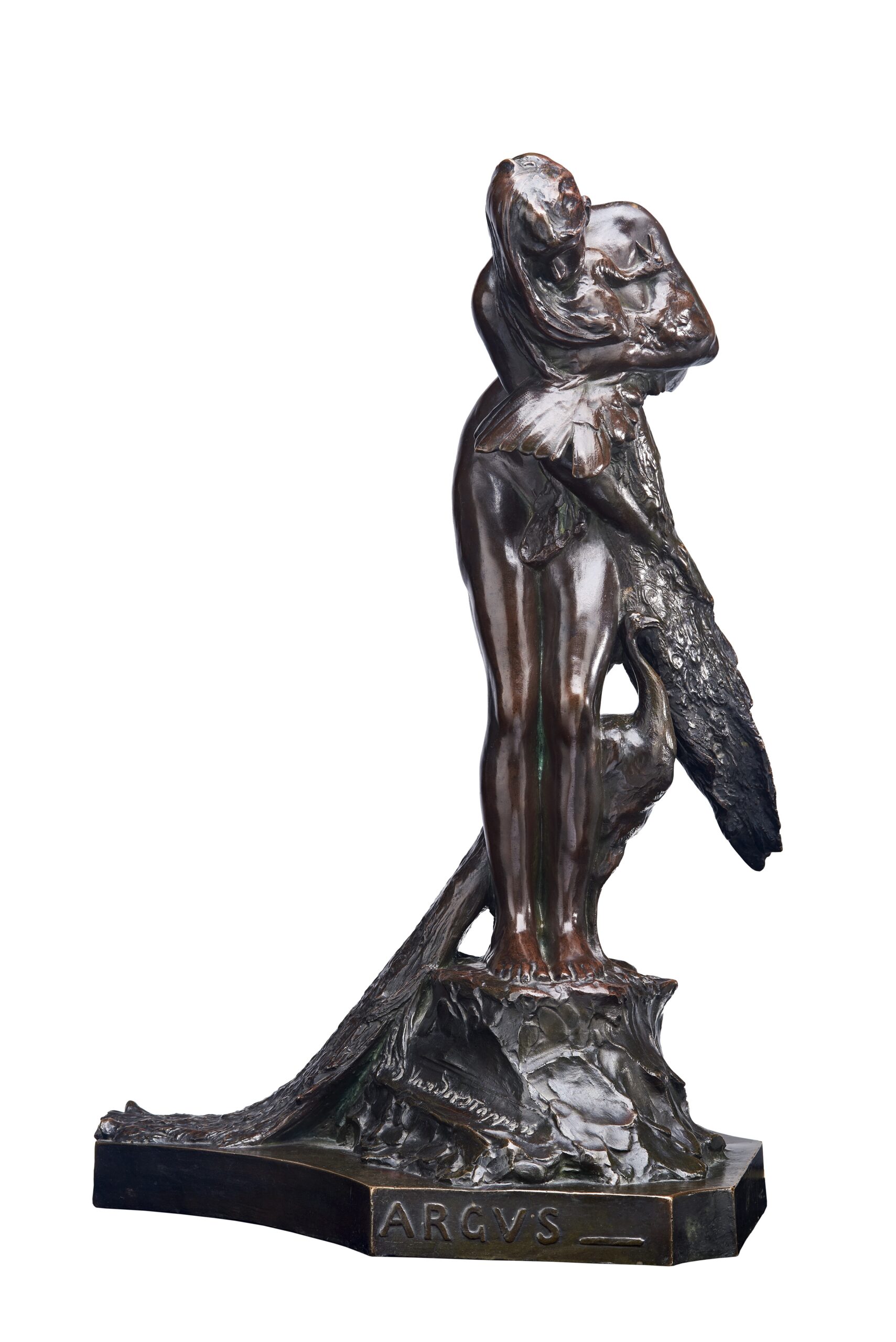
Argus
Woman with Peacocks
technical sheet
| ARTIST | Charles Van der Stappen |
| DATE | ca. 1897-1898 |
| material | Bronze |
| DIMENSIONS | Height 56,5 cm |
| Signature | VANDERSTAPPEN ARGUS • KK. / KUNSTERZGIEBEREI / WIEN |
| PROVENANCE | Private Collection • Germany |
| CONSERVATION | Private Collection • Belgium |
about the work
This bronze embodies the Belgian renaissance of sculpture that Van der Stappen championed across Europe. Exhibited at the Vienna Secession in 1898 — the year the artist was awarded its gold medal — it follows the undulating forms of Art Nouveau and captures the turn-of-the-century theme of the femme fatale. A supple line unites a nude woman with two peacocks and underscores the unity of the composition.
The work depicts the goddess Juno with her dedicated animal. In his Metamorphoses, Ovid recounts how Juno set the many-eyed giant Argus to guard Io; when Mercury slew him, the grieving goddess transferred his eyes to the peacock’s plumage. A version of the Sphinx, half human and half animal, guardian of inspiration and harbinger of death, the figure distils the whole of the artist’s Symbolist imagination.
The bodies merge in a curving movement that magnifies every viewpoint. This rare bronze was cast in Vienna by the K. k. Kunsterzgießerei foundry, whose director, Arthur Krupp, Van der Stappen recommended to Rodin in 1899.
the ARTIST
charles van der stappen
Brussels, 1843 — 1910, Brussels