Alfred Courtens · (1889–1967)
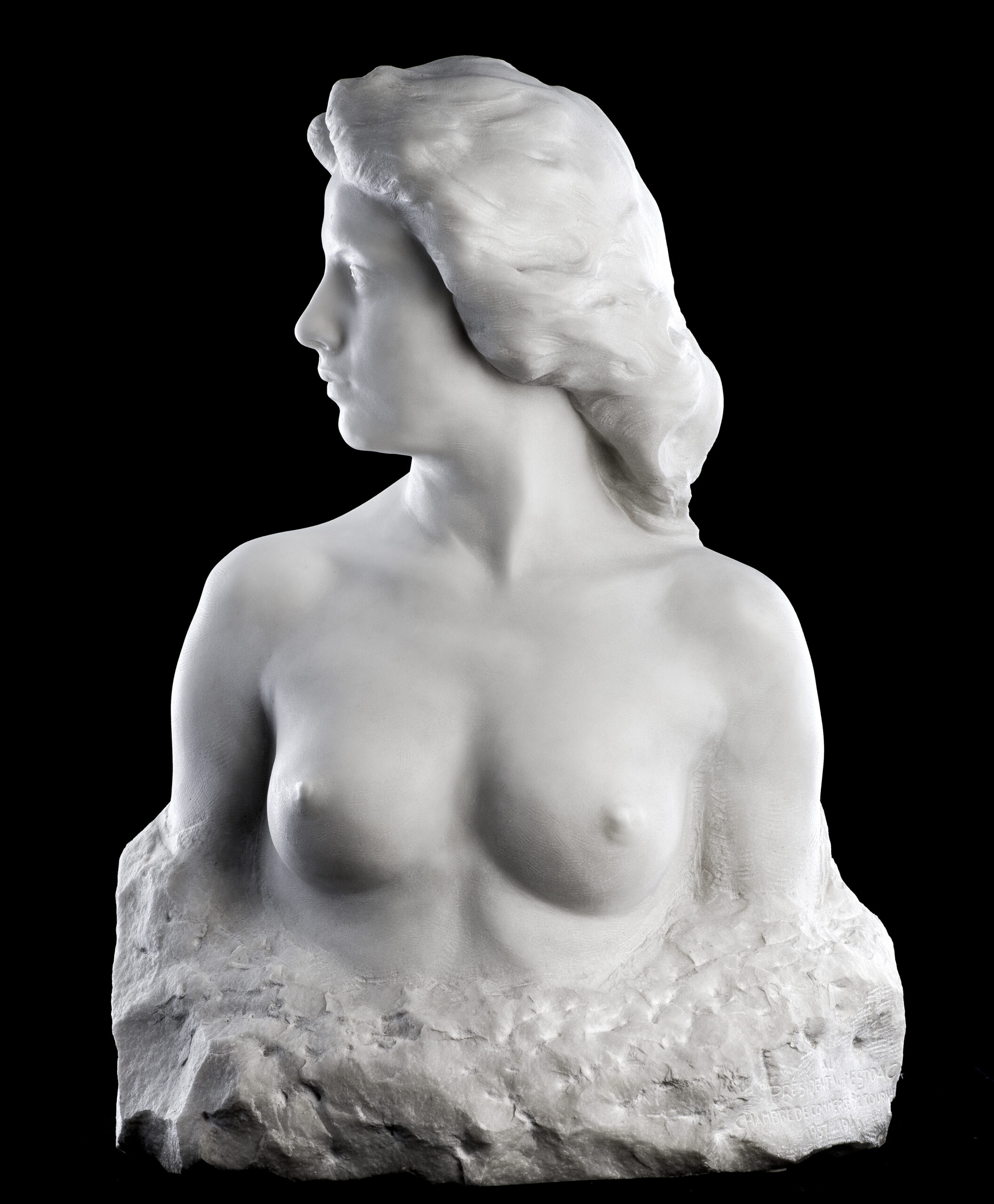
Bust of a young woman
technical sheet
| ARTIST | Alfred Courtens |
| DATE | ca. 1940 |
| material | White Carrara marble • original column in walnut root with a table in “Noir de Mazy” marble |
| DIMENSIONS | 72 x 52 x 35,5 cm |
| Signature | Alfred Courtens |
| PROVENANCE |
« Au Président W. Mestdag, chambre de commerce de Tournai, 1937-1945 » (dédicace) |
| CONSERVATION | Private collection, Belgium |
about the work
This bust of a young woman rests on a refined contrast between the supple physical forms and the roughly hewn lower zone from which the figure appears to rise. Courtens ably lends a subtle dynamic to an otherwise static sculpture: the mass of the model’s hair seems to follow the movement of her head, while the right shoulder, slightly raised, suggests a sudden gesture.
The marble bears a carved dedication — “Au Président W. Mestdag, chambre de commerce de Tournai, 1937-1945” — revealing that the sculpture was made as a gift for Mr W. Mestdag, President of the Chamber of Commerce of Tournai, in Belgium. The work is presented on its original column.
Cut from white Carrara marble worked to the point of an apparent translucency of the flesh, the bust showcases Courtens’s virtuosity in rendering skin and in the interplay of textures, from the most delicate polish to the stone left raw.
the artist
Alfred Courtens
Saint-Josse-ten-Noode, 1889 — 1967
Alfred Courtens was a realist sculptor who left behind an extensive and multifaceted oeuvre. The son of the painter Franz baron Courtens (1854-1943) and brother of the painter Herman Courtens (1884-1956), he studied at the Brussels Academy under Charles Van der Stappen (1843-1910), while at the Higher Institute in Antwerp Thomas Vinçotte (1850-1925) became his mentor. In 1913 he won the coveted Godecharle prize, which allowed him to visit Italy before teaching at the Academy of Dendermonde.
The author of monumental sculptures, portraits and medals shown at countless salons, he also regularly exhibited allegorical and mythological works in marble and bronze. His close ties with the Belgian Royal Household brought significant commissions — monuments of homage and equestrian statues — as well as numerous acquisitions. Several Belgian museums hold his works, and as early as 1911 he was awarded a gold medal in Barcelona.