alexandre falguière · (1831–1900)
Circe
TEchical sheet
| ARTIST | Alexandre Falguière |
| DATE | Late 19th century |
| material | White Carrara marble |
| DIMENSIONS | Height : 99 cm |
| Signature | A. FALGUIERE |
| PROVENANCE | |
| CONSERVATION | Private collection • China |
about the work
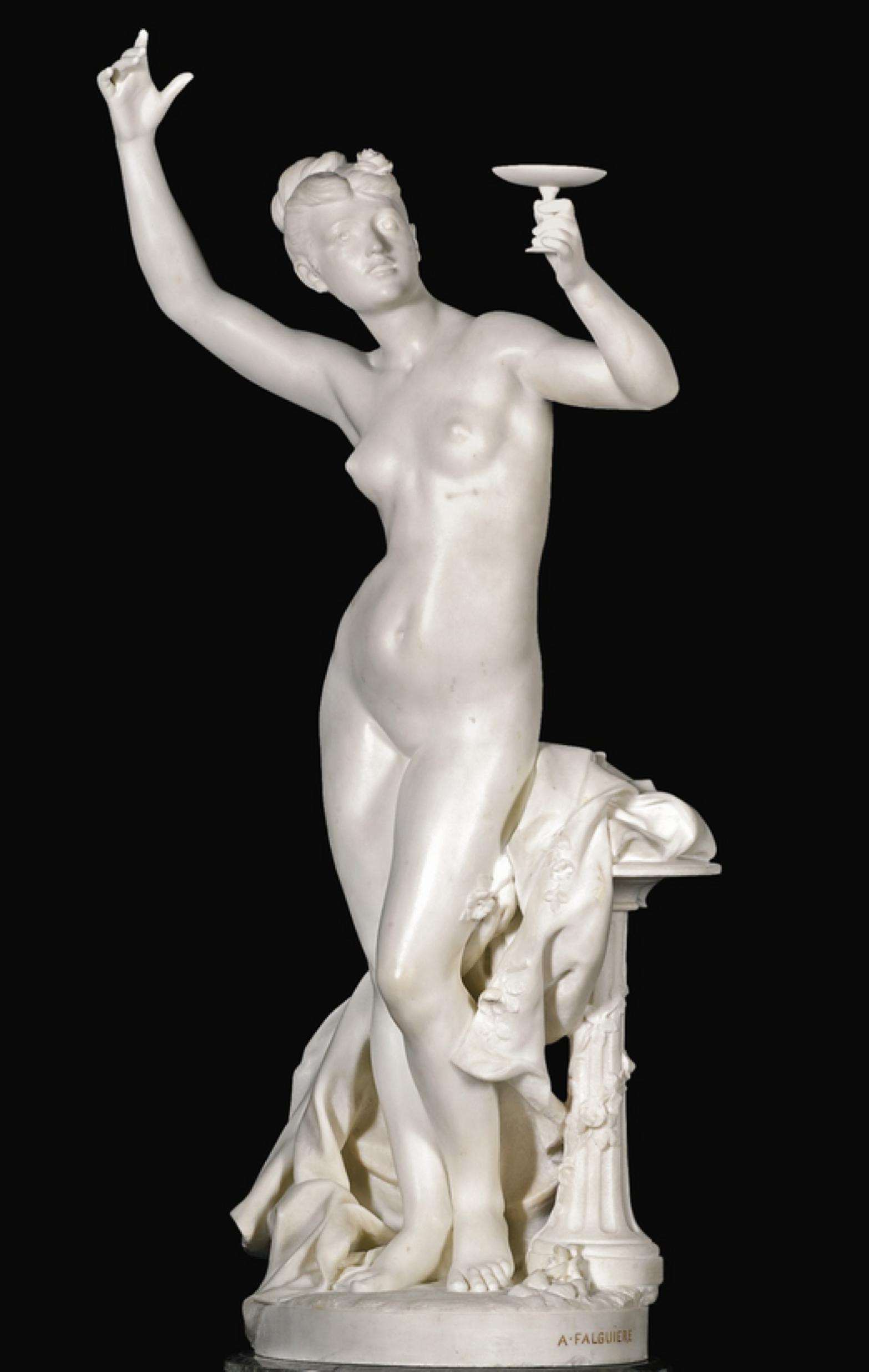
This marble sculpture depicts Circe, the sorceress of Greek mythology, a nymph and enchantress renowned for her profound mastery of potions and herbs. Wielding her brews together with a magic wand or staff, she transformed those who crossed her. Falguière captures her in a single suspended moment, poised between seduction and menace.
The artist renders her as a nude woman of sovereign beauty, raising a cup towards the gods. The gesture, at once an offering and an invitation, distils the whole ambiguity of the figure. The modelling of the marble conveys the softness of the flesh and the tension of the muscles with that pursuit of extreme realism for which Falguière was celebrated, a sculptor unusually attentive to the accuracy of his proportions.
A work of the master’s full maturity, this Circe exemplifies how late nineteenth-century French sculpture reconciled the classical ideal with a distinctly modern sensuality. The whiteness of the Carrara marble, the fluid pose and the delicacy of the carving lend the figure a presence that is both carnal and timeless.
the artist
alexandre falguière
Toulouse, 1831 — 1900, Paris
Alexandre Falguière ranks among the most celebrated French sculptors of his day. Sent to Paris as a young man by his father, he trained under Carrier-Belleuse before entering, in 1854, the École des Beaux-Arts in François Jouffroy’s renowned studio. In 1859 he won the prestigious Prix de Rome; his Italian years produced the famous “Vainqueur au combat de coqs,” acquired in marble by Napoleon III himself.
Awarded the Légion d’honneur in 1889, a professor at the École des Beaux-Arts and later a member of the Académie des Beaux-Arts, he adorned the Paris Opéra, the Arc de Triomphe and the Comédie-Française. He portrayed Victor Hugo, Corneille and his friend Rodin. The Musée d’Orsay holds several of his works, including “Tarcisius” and “Omphale.”