RAOUL-FRANÇOIS LARCHE · (1860–1912)
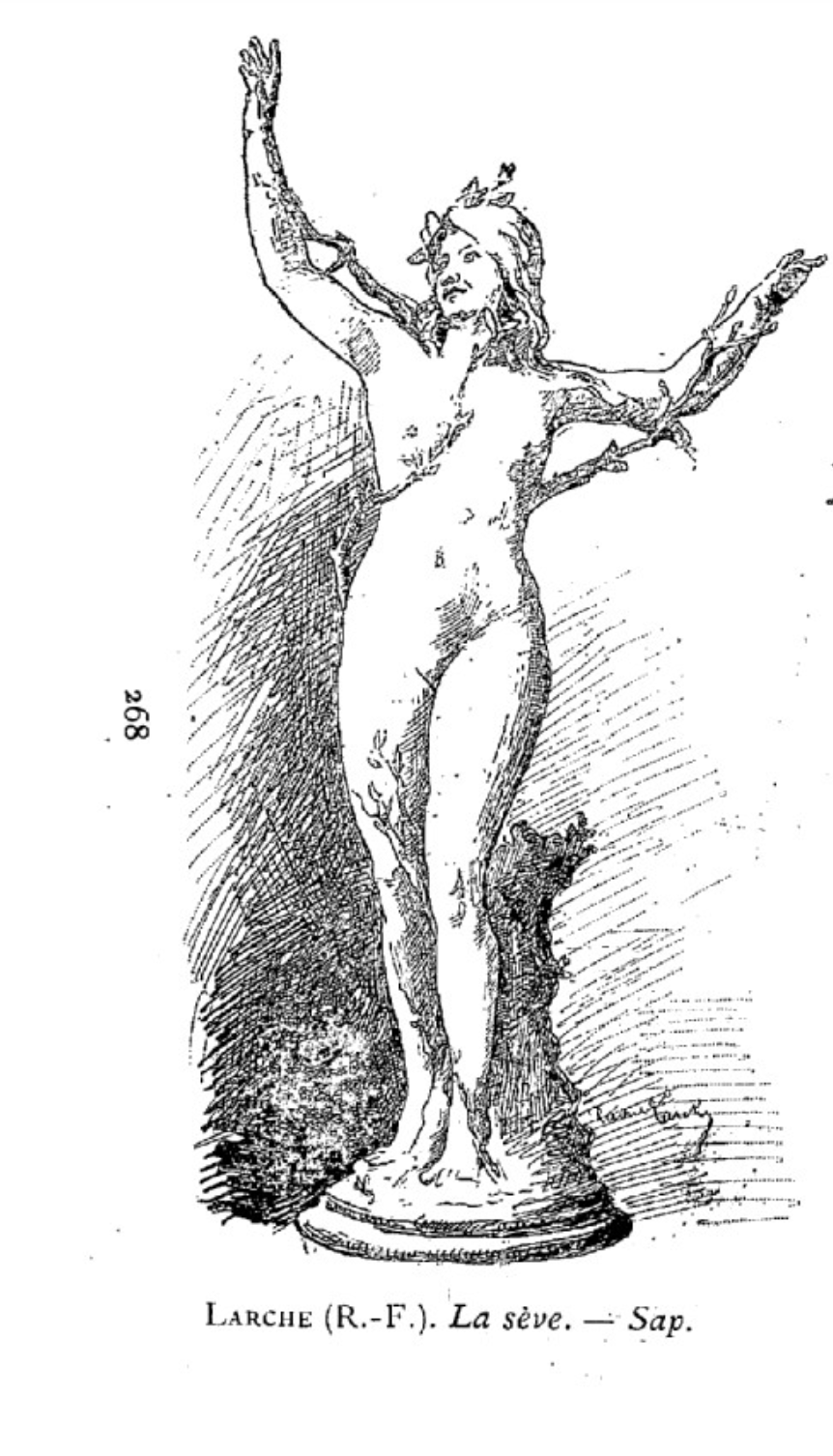
La Sève
technical sheet
| ARTIST | Raoul-François Larche |
| DATE | Plaster: 1893 / Sculpture : ca. 1900 |
| DIMENSIONS | Height: 98 cm |
| MATERIAL | White Carrara marble |
| SIGNED | “RAOUL LARCHE” |
about the work
La Sève is an allegory of the arrival of spring and the rising of sap in nature. It depicts a joyful woman, her arms raised toward the sky, her body entwined with branches from which buds are blossoming. Édouard Larche, the sculptor’s brother, described it: “The branches represent the wind along the body, enveloping it with its leaves and buds full of sap, whose gesture, arms raised, seems to accentuate the germination.”
The body, with its beautiful carnation, embodies fertility and the glorification of nature. The face is that of Georgette Lecoeur, the artist’s regular model for his great allegorical figures, and is inscribed in the idealized academic canon, with ornamental incursions close to Art Nouveau.
The work was first exhibited at the Salon des Artistes Français of 1893 (no. 3055) in plaster. The monumental marble was commissioned by the State for the Salon of 1909, then assigned to the Ministry of Agriculture. The plaster was donated by the artist’s widow to the Musée des Beaux-Arts de Bordeaux in 1920.
Literature
- WILLI, Arthur. Le multiple dans l’œuvre de Raoul Larche. Mémoire de recherche de master 1 en histoire de l’art, sous la direction de Jérémie Cerman, Université Paris-Sorbonne, 2021.
the ARTIST
Raoul-François Larche
Saint-André-de-Cubzac, 1860 – Lagny, 1912
French sculptor at the crossroads of academic tradition and Art Nouveau, celebrant of the allegorical woman and lush vegetation. Raoul-François Larche was born on 22 October 1860 in Saint-André-de-Cubzac, in the Gironde. Admitted on 13 August 1877 to the École des Beaux-Arts in Paris, he trained successively under François Jouffroy then Alexandre Falguière until 1888, also benefiting from the teaching of Eugène Delaplanche and Jean-Léon Gérôme.
similar works