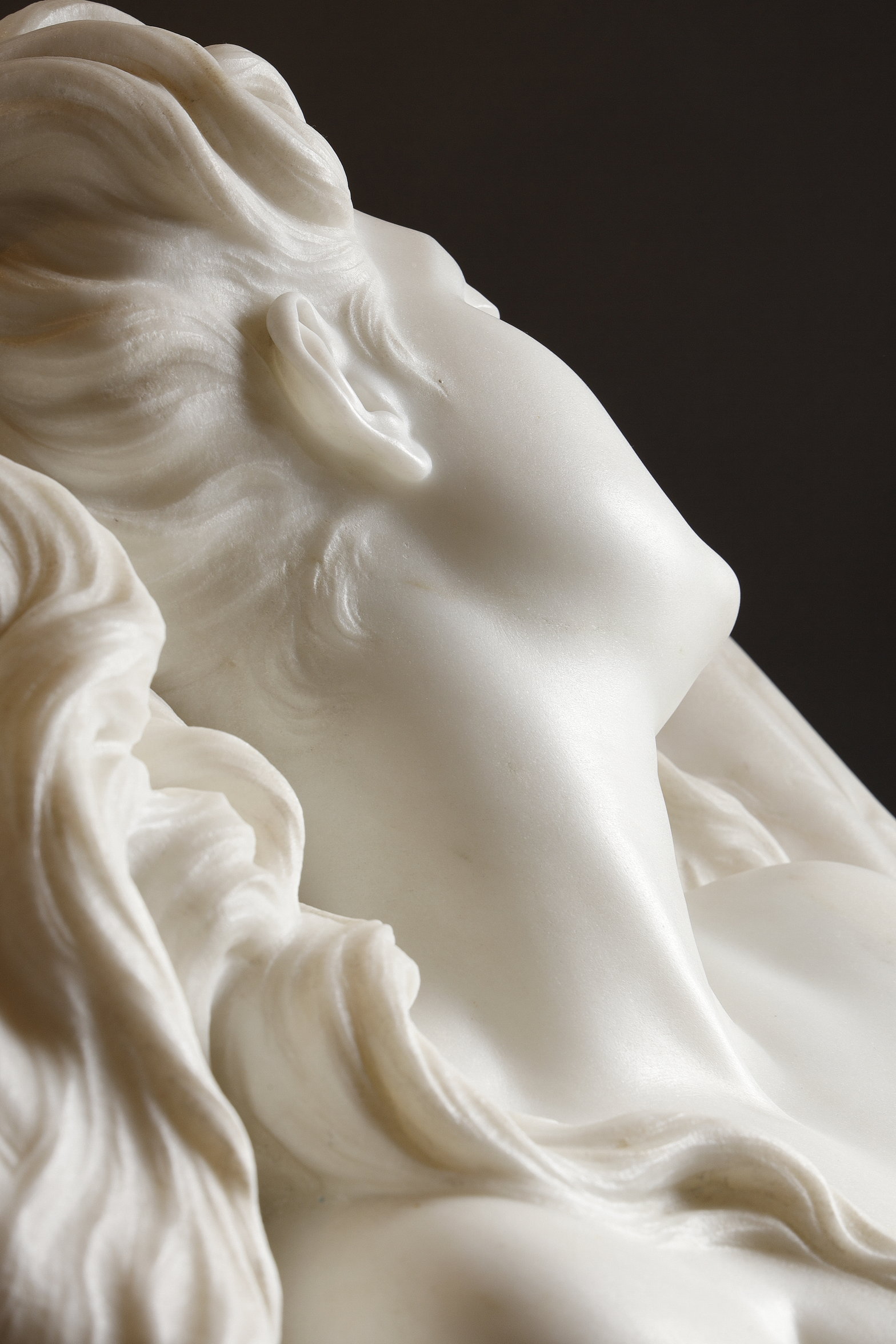
prosper d’epinay · (1836–1914)
Midsummer Night’s Dream
technical sheet
| ARTIST | Prosper d’Epinay |
| DATE | ca. 1870 |
| material | White Carrara marble |
| DIMENSIONS | 56 x 66 x 52 cm |
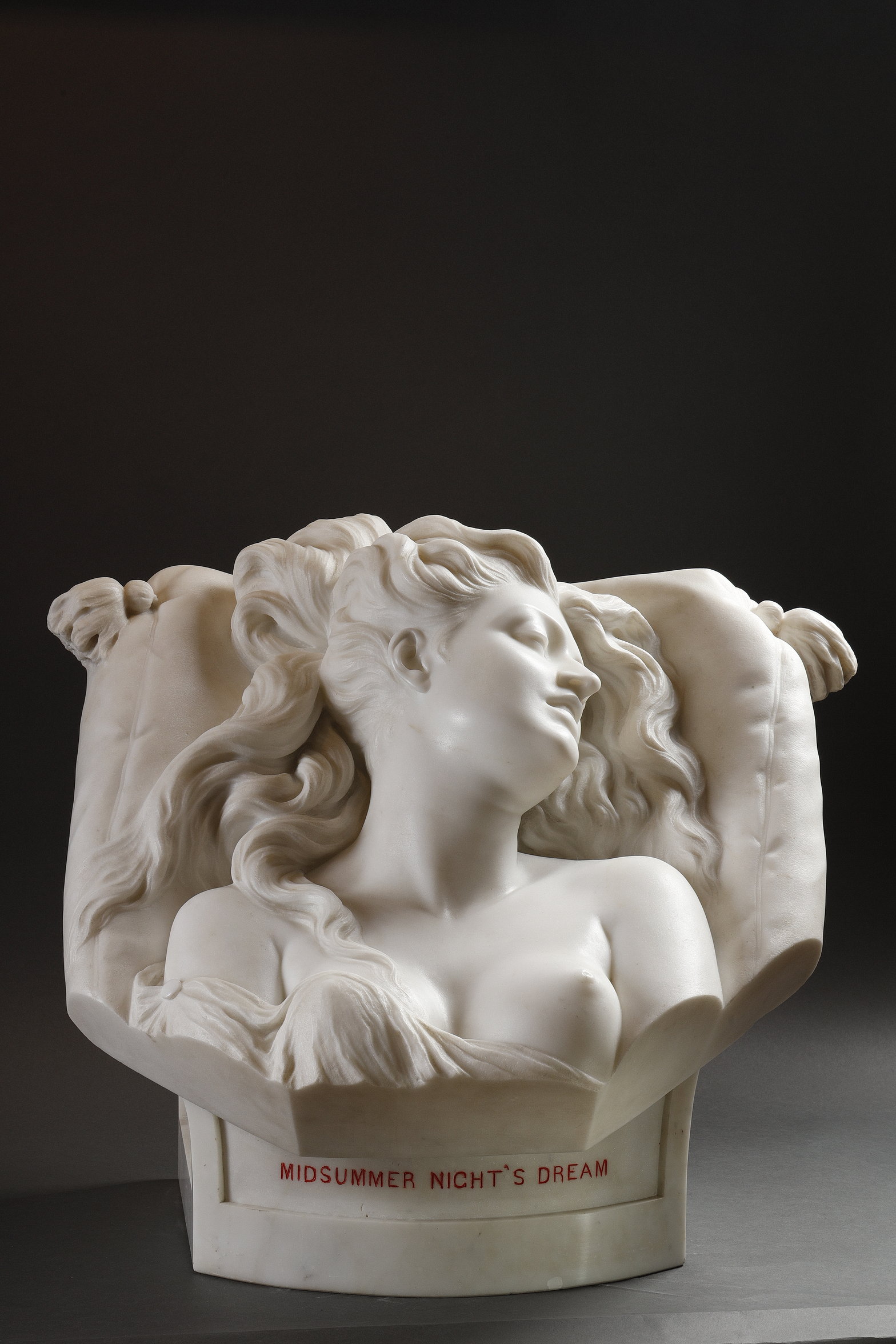
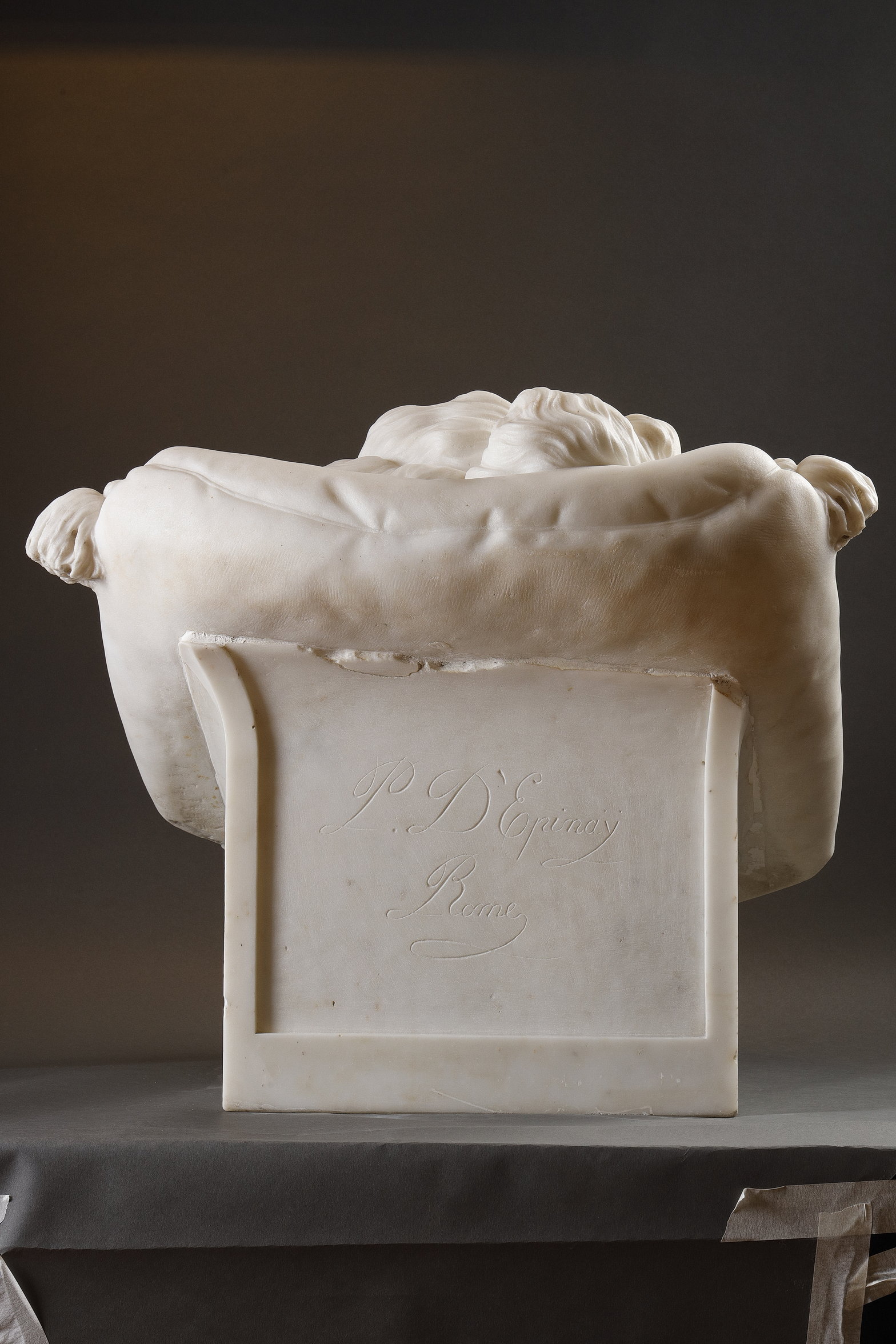
| SIGNATURE | P. d’Epinay Rome |
| TitlE | Midsummer Night’s Dream |
| Provenance | Private collection • Germany |
about the work
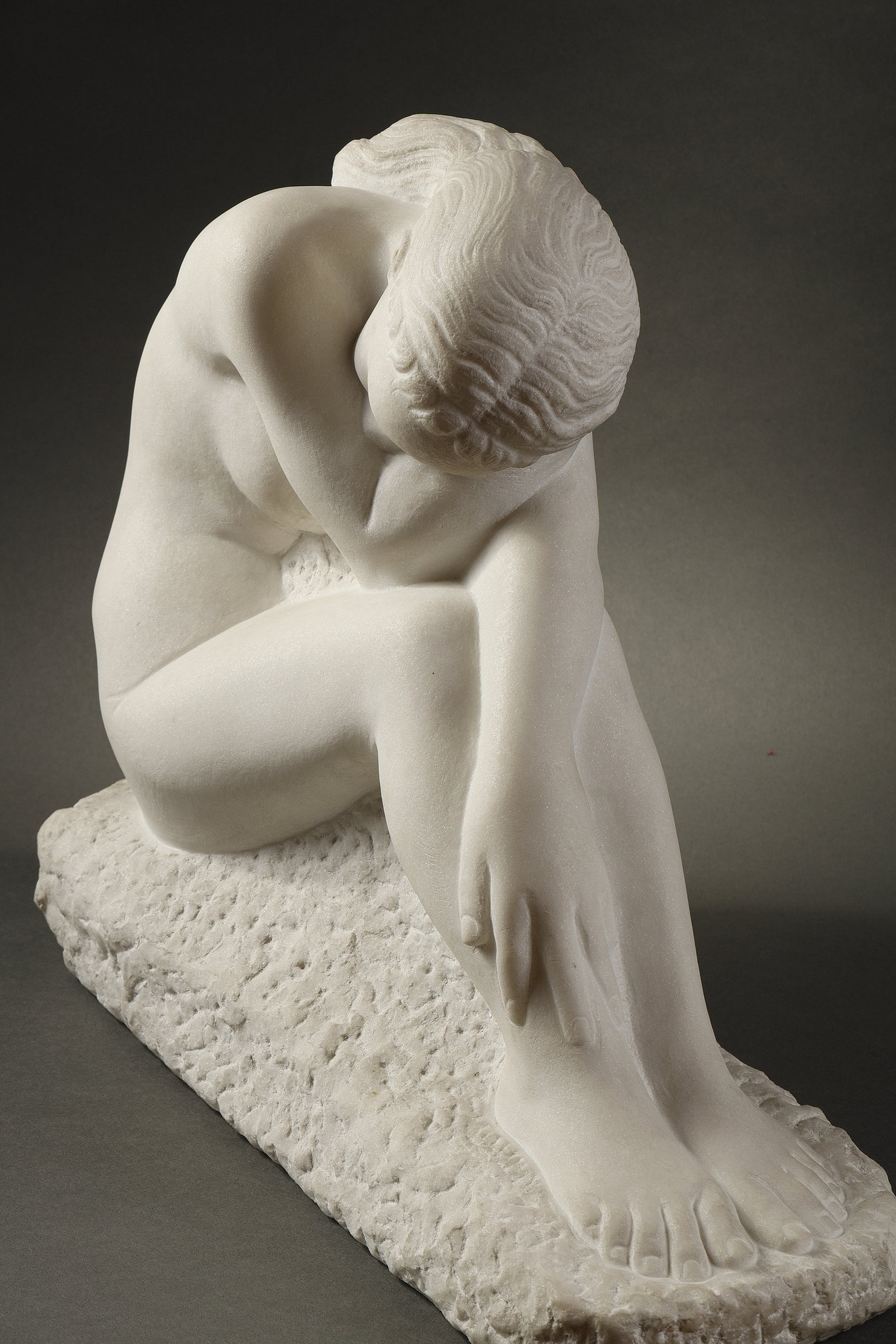
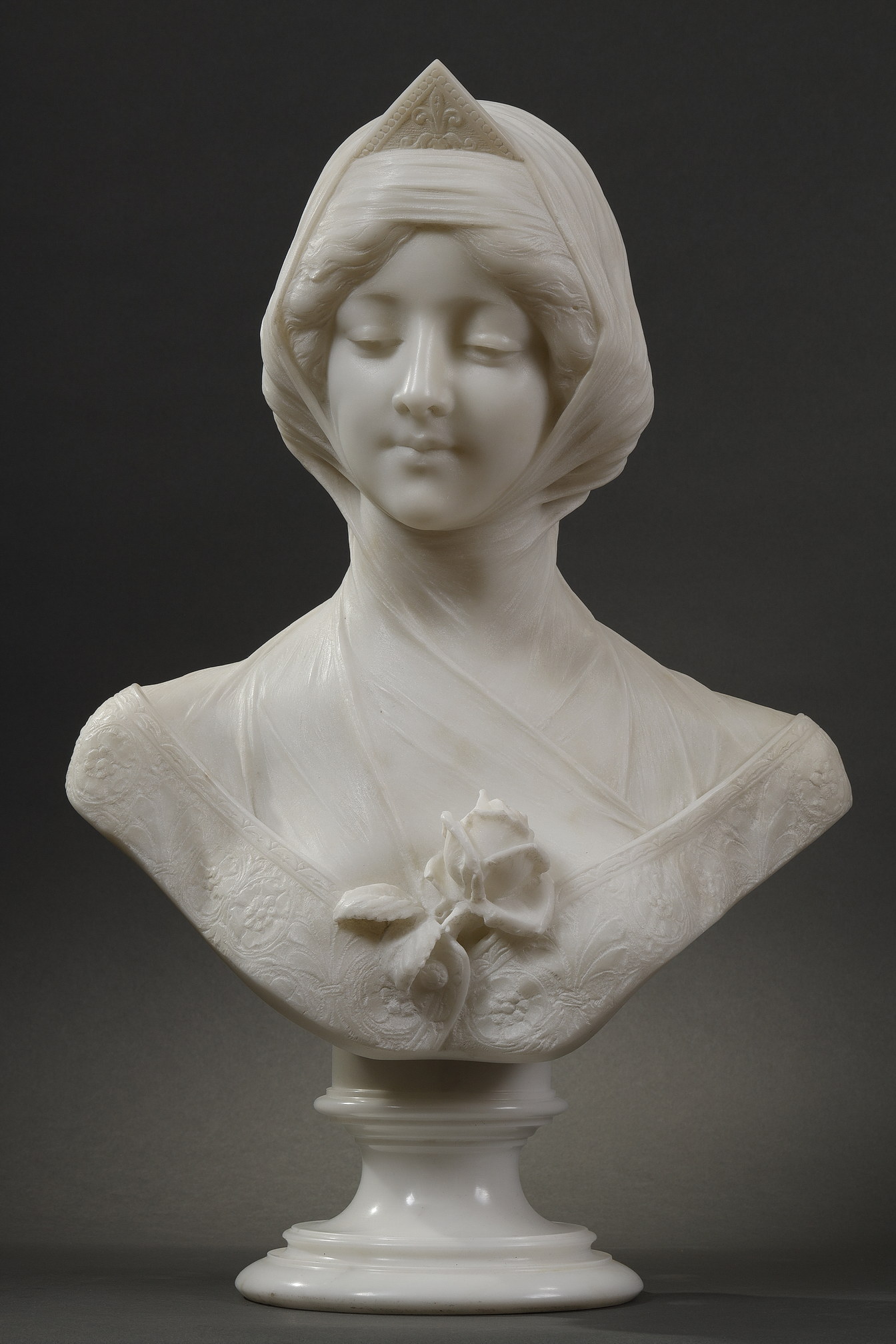
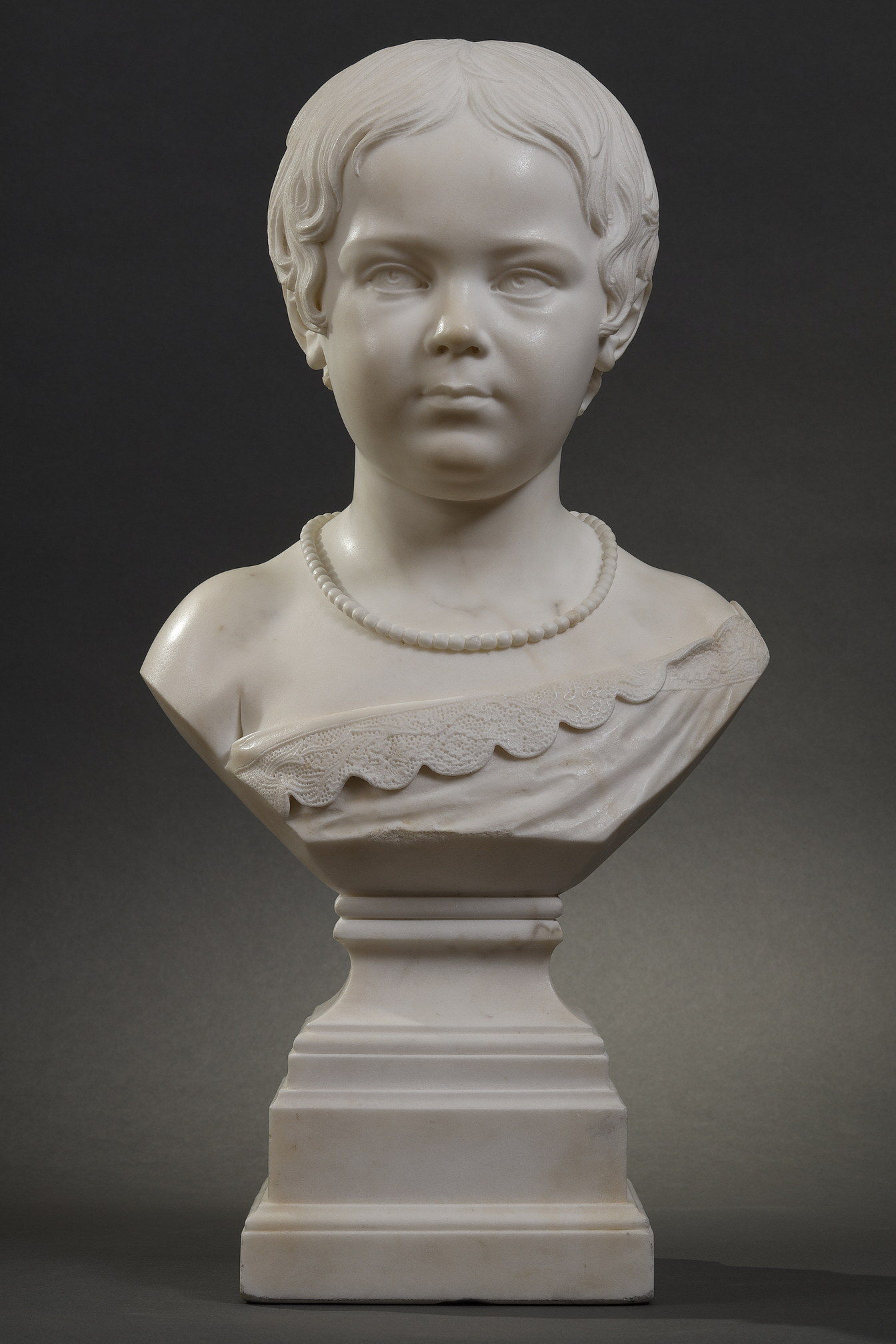
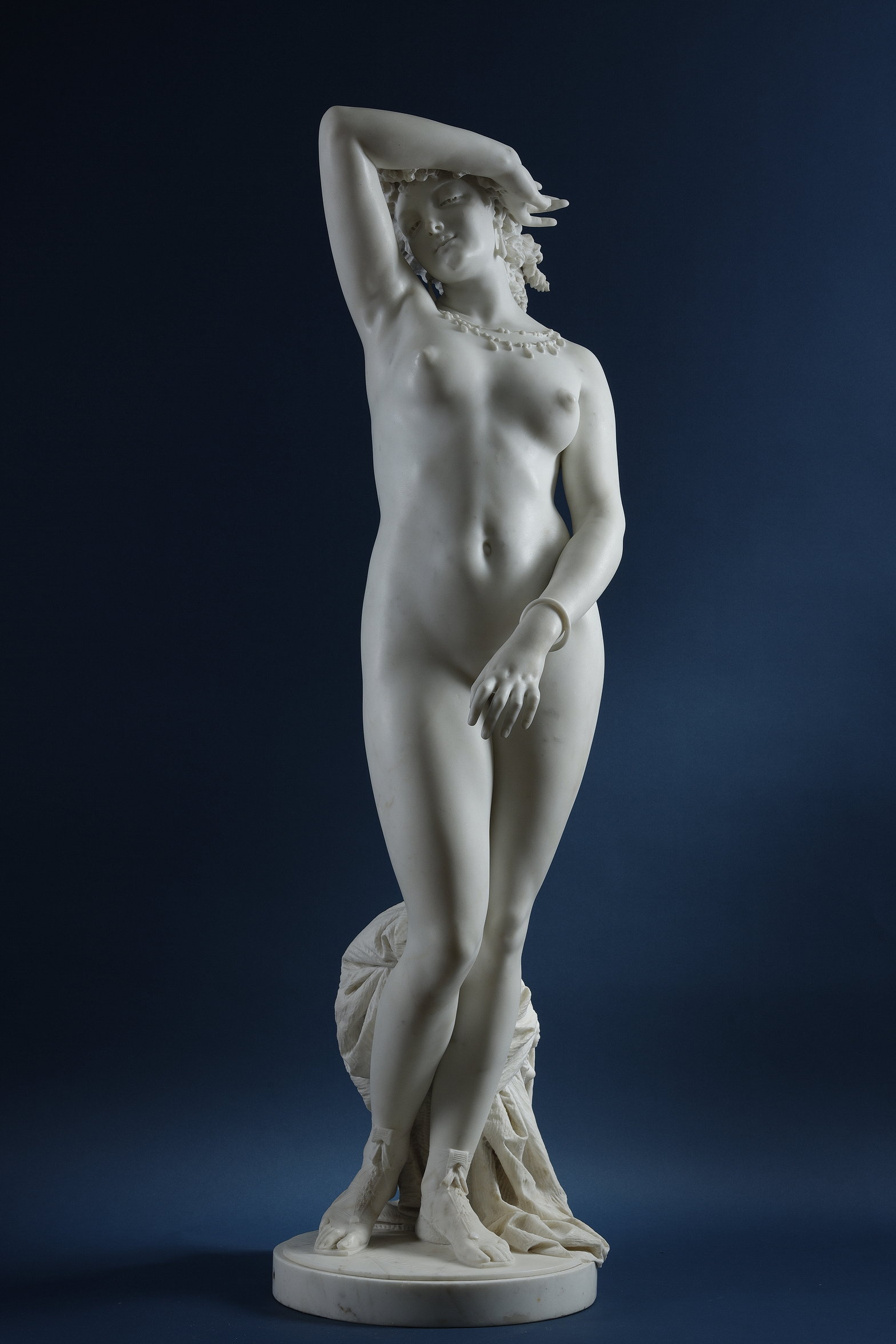
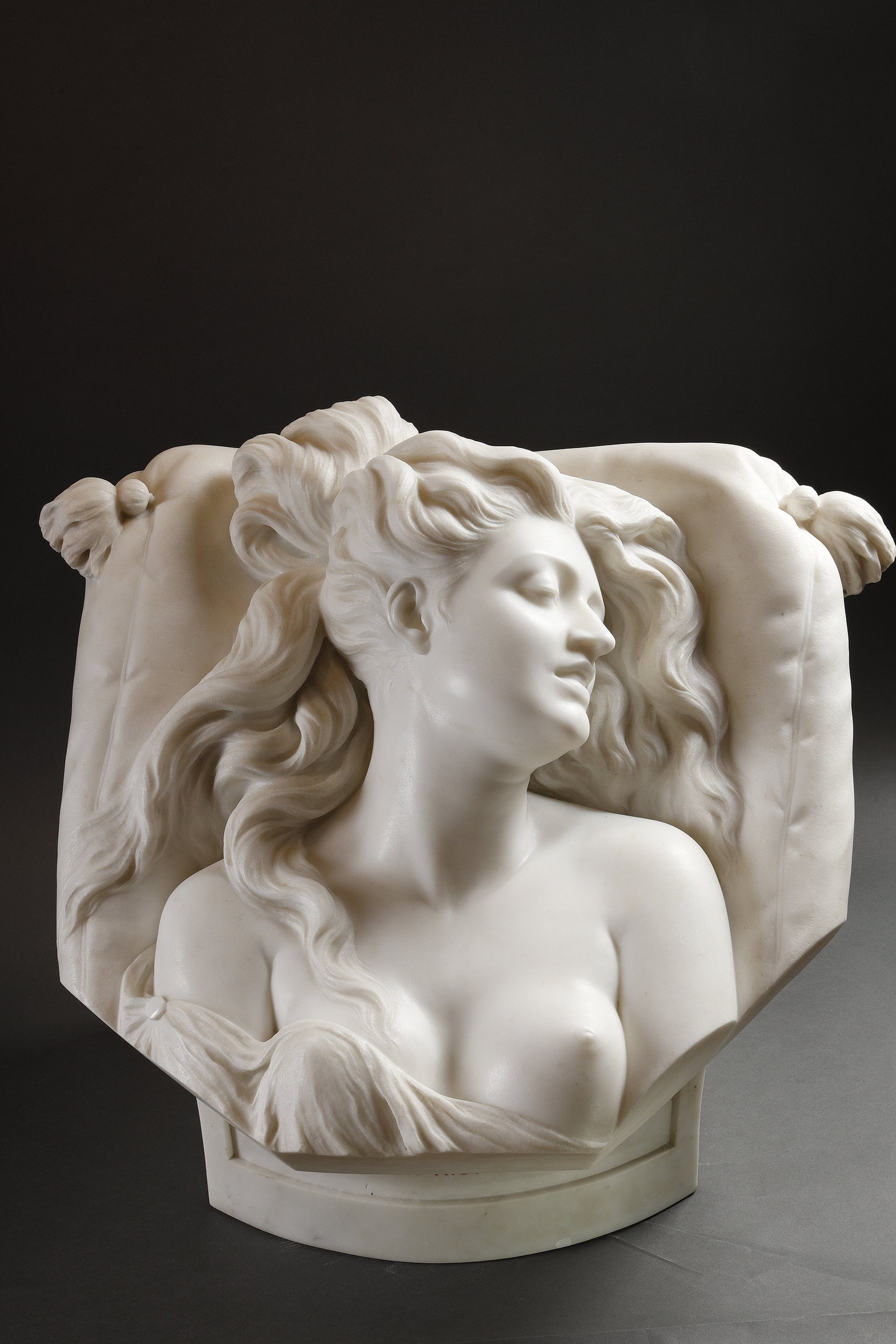
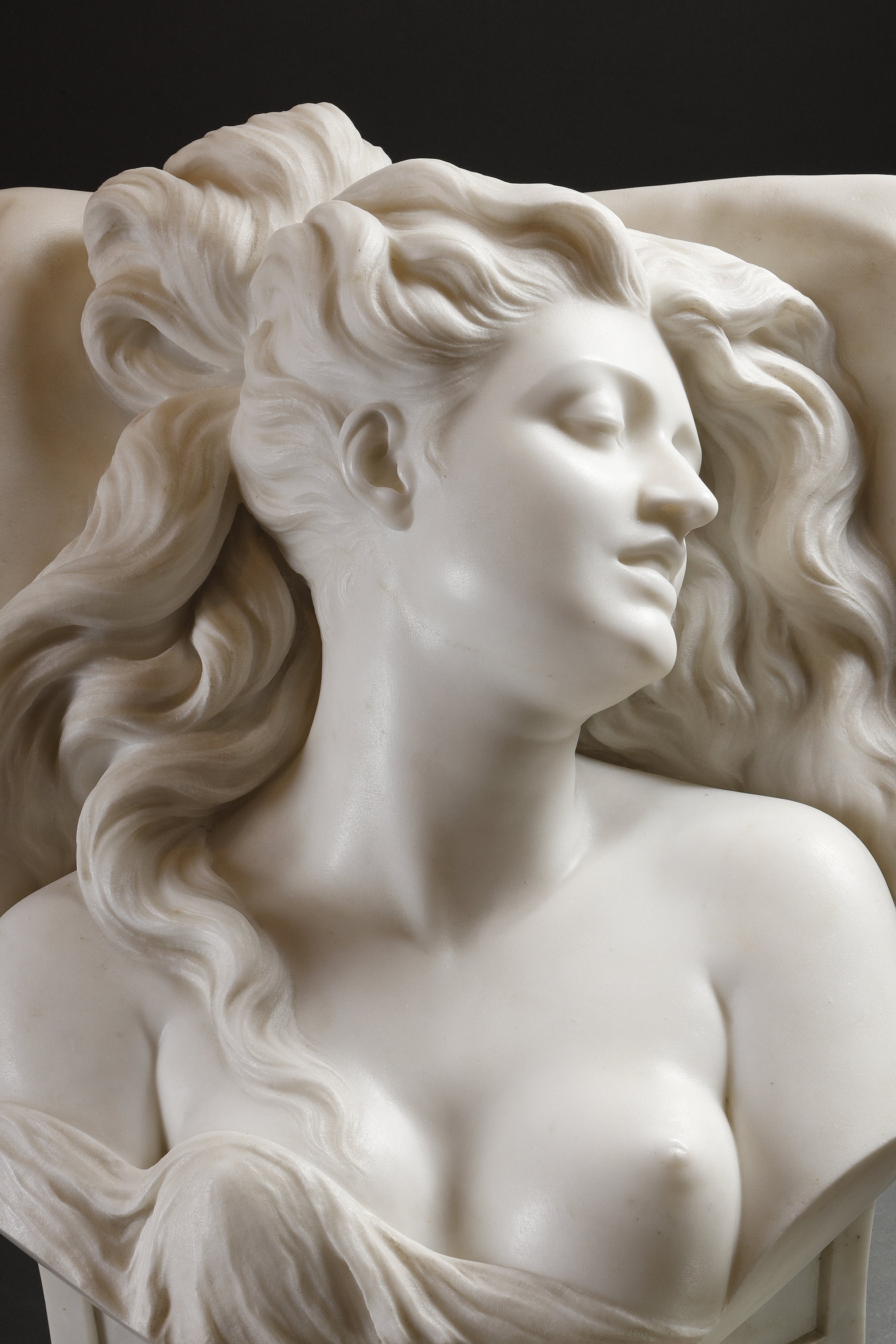
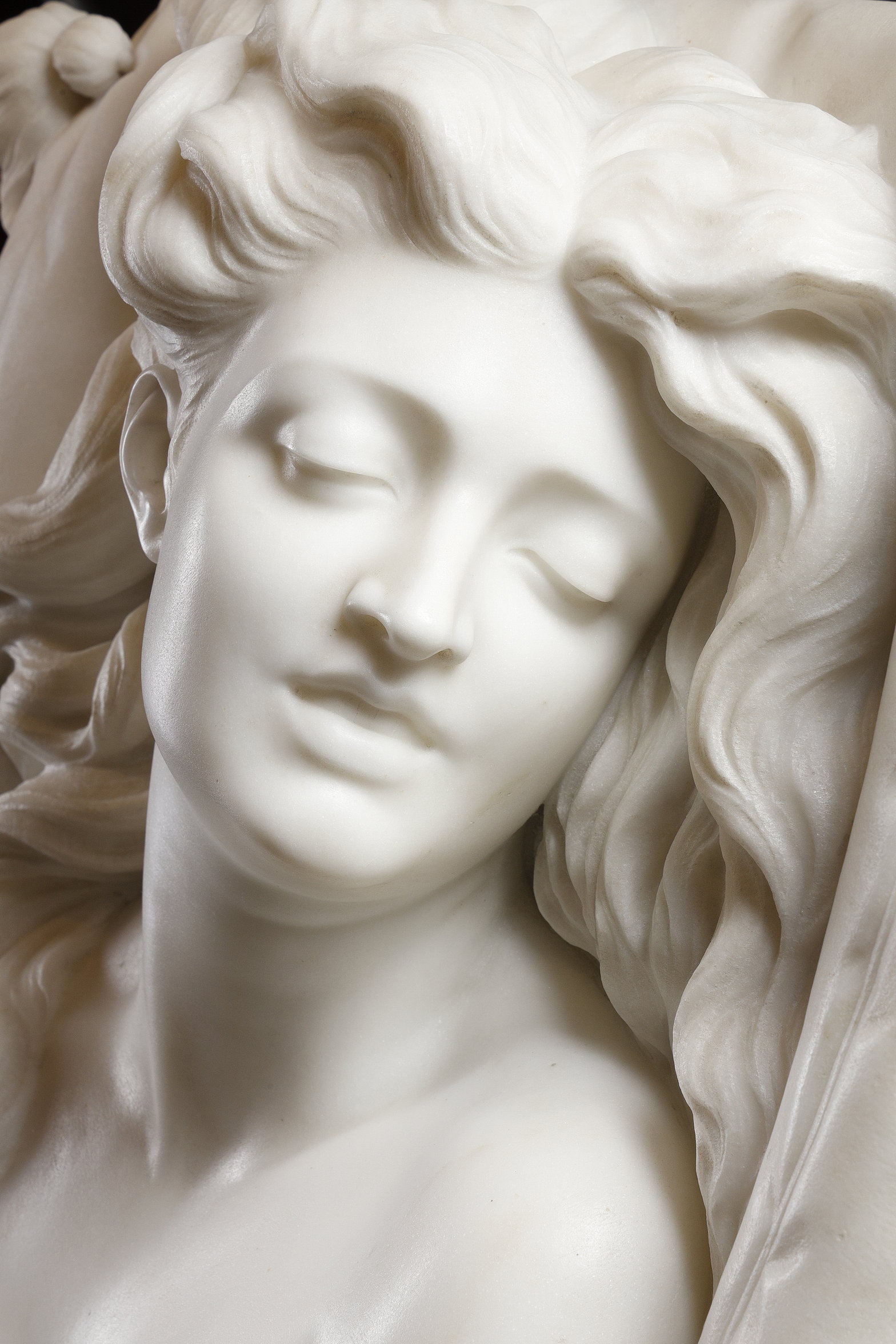
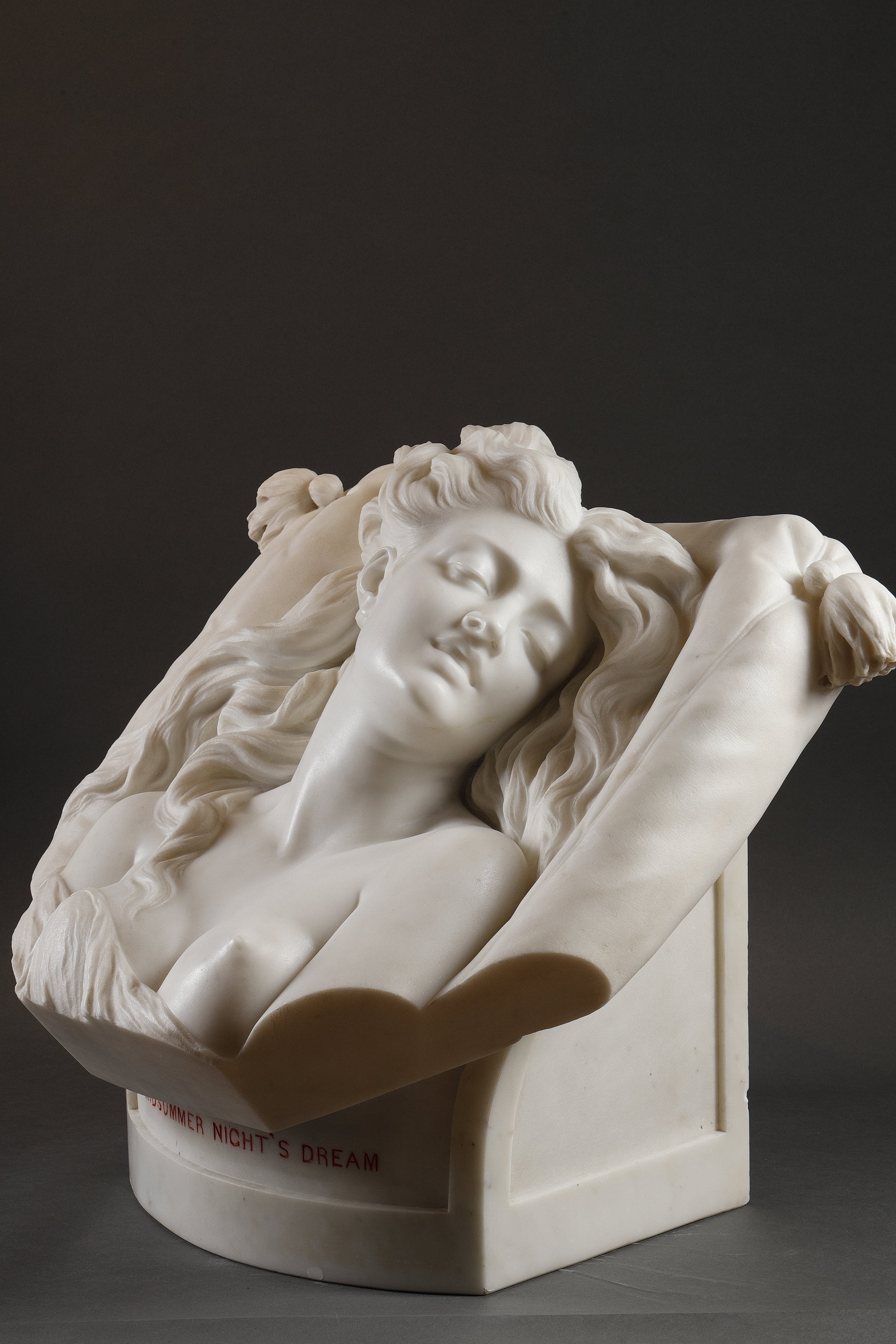
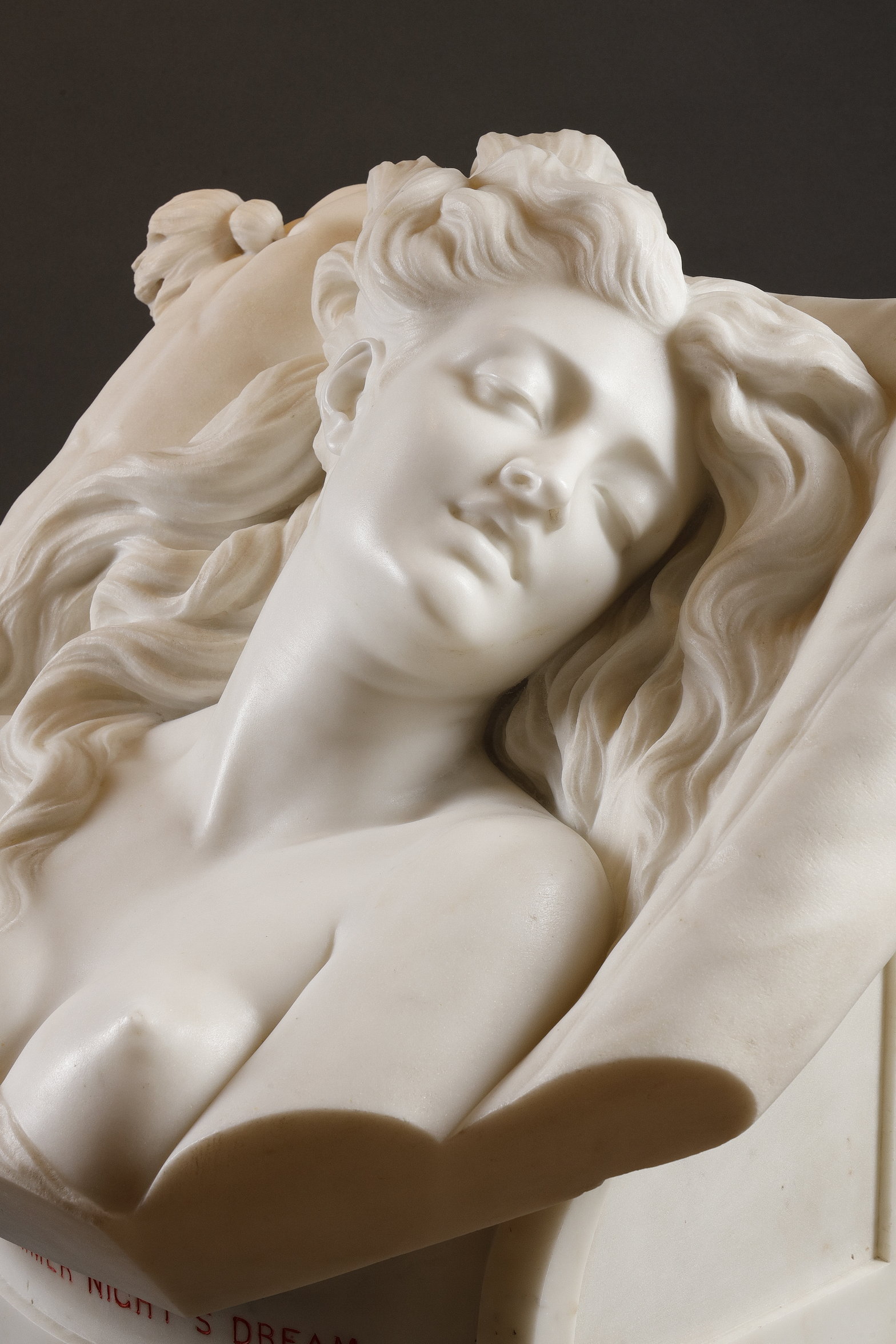
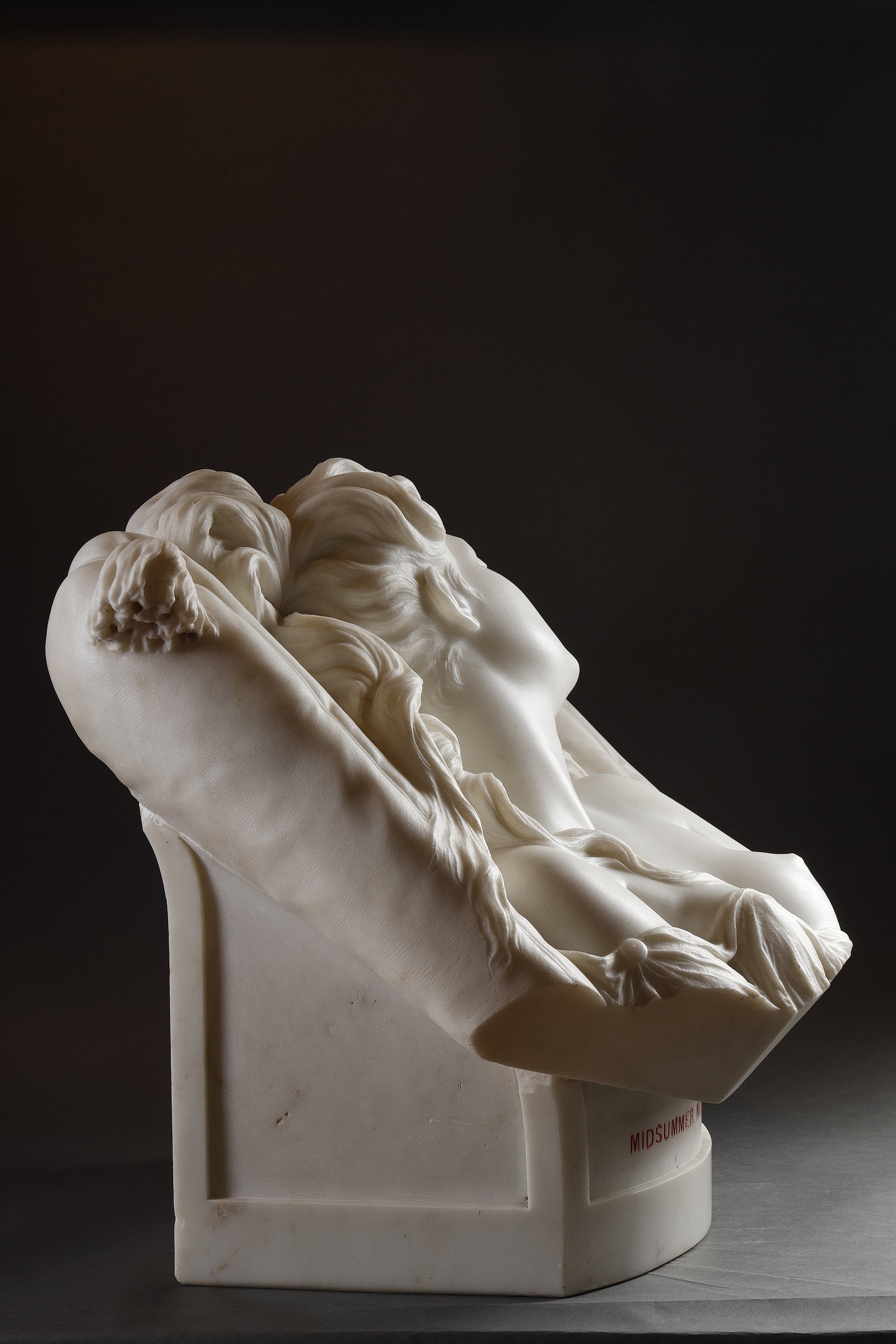
This white marble bust depicts a female figure with a half-bare torso, her head thrown back, resting on a cushion, in a movement of dreamy abandon. The eyes are half-closed, the lips slightly parted, the features imbued with a serenity that evokes the state of suspension between sleep and waking. The hair, rendered with exceptional virtuosity, spreads in free and tumultuous waves flowing around the face and neck, creating an effect of movement characteristic of D’Epinay’s manner.
The bust belongs to a coherent group of works within D’Epinay’s output, characterised by the recurring motif of a female figure with half-closed eyes in a state of dreamlike abandon. Comparison with the Bacchante (dated 1866, Hermitage Museum collections) reveals a face with precisely the same features: the same straight nose, the same slightly parted lips, the same backward tilt of the neck, the same half-closed eyes. This confirms that the type represents D’Epinay’s favoured female ideal throughout his Roman and Parisian career, most likely derived from a single model or a single plastic source interpreted anew.
Comparison with Le Rêve, reproduced in the artist’s catalogue raisonné and described as having belonged to the Musée de Mahebourg in Mauritius, is equally striking: the same features, the same position of the head, the same treatment of the hair enriched with floral and foliate motifs. A manuscript annotation in a copy of the biography written by Léoville L’Homme (Le Statuaire Prosper d’Epinay, 1890) indicates that this bust was destroyed in a fire, which makes the related works to have survived all the more precious.
The signature “P. D’Epinay Rome” places the execution within the artist’s Roman period, that is between 1863 and the 1880s, when D’Epinay was working in his studio on the Via Sistina.
The sale of Prosper D’Epinay’s studio in Paris (Drouot) in 1885 mentions a work entitled Songe d’une Nuit d’Été measuring one metre. The present bust of 56 cm may constitute a reduced version, an earlier version, or an autonomous treatment of the same subject produced for a particular commission.
The title Midsummer Night’s Dream places this work firmly within the world of Shakespeare’s comedy, and more precisely within one of its most celebrated and poetically charged moments of irony: that in which Titania, Queen of the Fairies, lies sleeping in her enchanted bower, under the effect of the magic juice poured upon her eyelids by Puck at the behest of Oberon, her husband. She remains intact in her sovereignty, still queenly in her beauty, yet the spell is already within her, and upon waking she will fall in love with the first living creature her gaze encounters, Bottom, the coarse weaver fitted with the head of a donkey.
It is precisely this suspended instant that D’Epinay has chosen to fix in marble: the last moment of Titania’s innocence, the one that precedes her fall into absurdity and comic abjection.
The half-closed eyes, the slightly parted lips, the head gently thrown back, everything conspires to render a sleep that is no ordinary rest, but an altered state, an in-between where consciousness is suspended and will is annihilated. The Queen of the Fairies is here in all her grace and power, and yet utterly vulnerable, offered up to a spell she cannot even sense approaching.
This choice of the ante moment, before the metamorphosis, before the humiliation, before the awakening, is of remarkable dramatic subtlety. Prosper D’Epinay does not depict the farce; he depicts its threshold. He captures the beauty of Titania at the precise instant when she is still wholly herself, in that suspension of time proper to the Shakespearean dream.
The Mauritian sculptor, to whom Parisian critics credited the gift of seizing l’heure , that moment of absolute perfection which the Greeks named thus, could not have chosen more finely. Titania’s hour is this one: the final second of the dream before the magic turns against her.
Literature
- Leoville l’Homme. Le statuaire Prosper d’Épinay. Port-Louis (Île Maurice) : Imprimerie de The Merchants and Planters Gazette, 1890.
- Vente d’Épinay. Catalogue de sculptures, groupes, statues, bustes, terres cuites originales décorées, maquettes, esquisses, bronzes fondus à cire perdue, tableaux modernes, objets d’art et de curiosité formant les collections de M. d’Épinay. Paris : Hôtel Drouot, 20–21 avril 1885. Commissaire-priseur : M. Escribe ; expert : A. Bloche.
- Capobianchi, Vincenzo, éd. Catalogue des marbres antiques et des objets d’art provenant de l’héritage des Princes Borghèse : collections du Musée du Pavillon de l’Horloge (Villa Borghese), à Rome. Rome : Pavillon de l’Horloge, Villa Borghese, 1893
- Roux Foujols, Patricia. Prosper d’Épinay (1836–1914) : un Mauricien à la cour des princes. Curepipe, Île Maurice : L’Amicale Maurice-France, 1996.
the ARTIST
Prosper d’Epinay
Port-Louis, 1836 — 1914, Paris
Born in Port-Louis in 1836 into an illustrious Creole family, Prosper d’Épinay grew up in France and showed exceptional gifts for drawing from an early age. Trained in Amici’s studio in Rome from 1861, he was encouraged by the collector Eugène Piot from his very first marbles.
similar works