FRANCESCO BARZAGHI · (1839–1892)
Phryne Before Her Judges
technical sheet
| ARTIST | Francesco Barzaghi |
| DATE | ca. 1865 |
| DIMENSIONS | 130 cm (Height) |
| MATERIAL | White Carrara marble |
| SIGNED | “F. Barzaghi Milano” |
| PROVENANCE | Collection privée, France. |
about the work
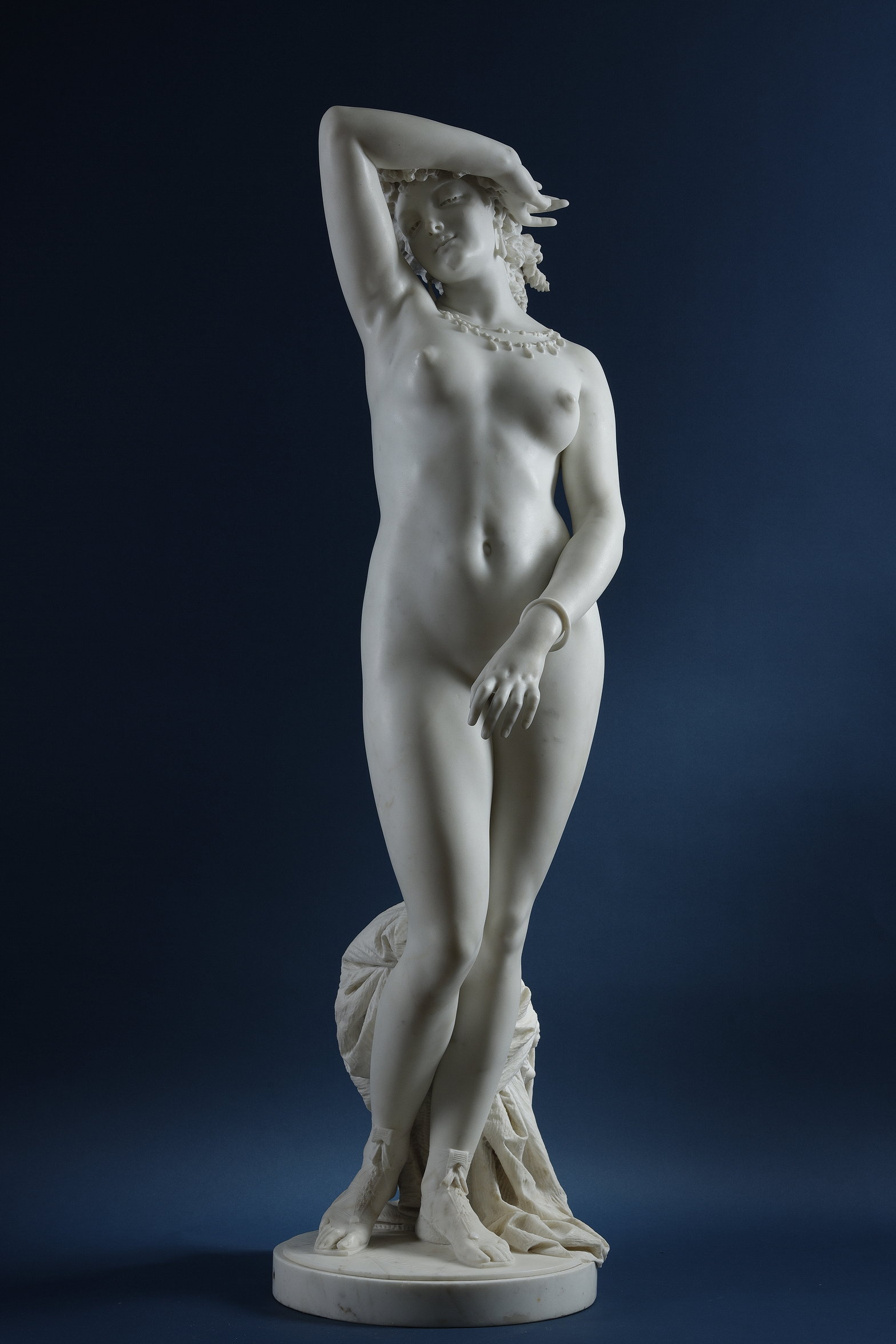
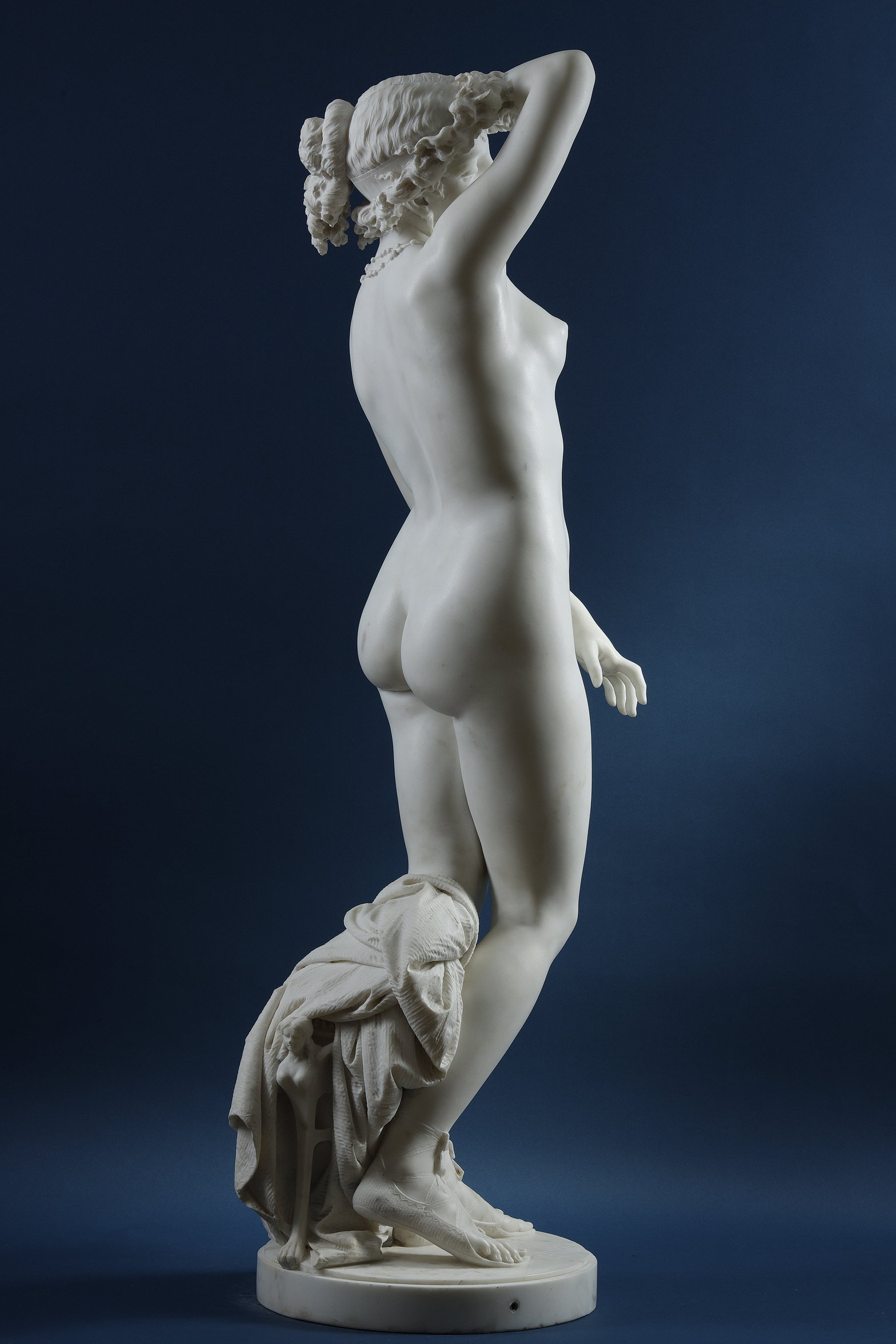
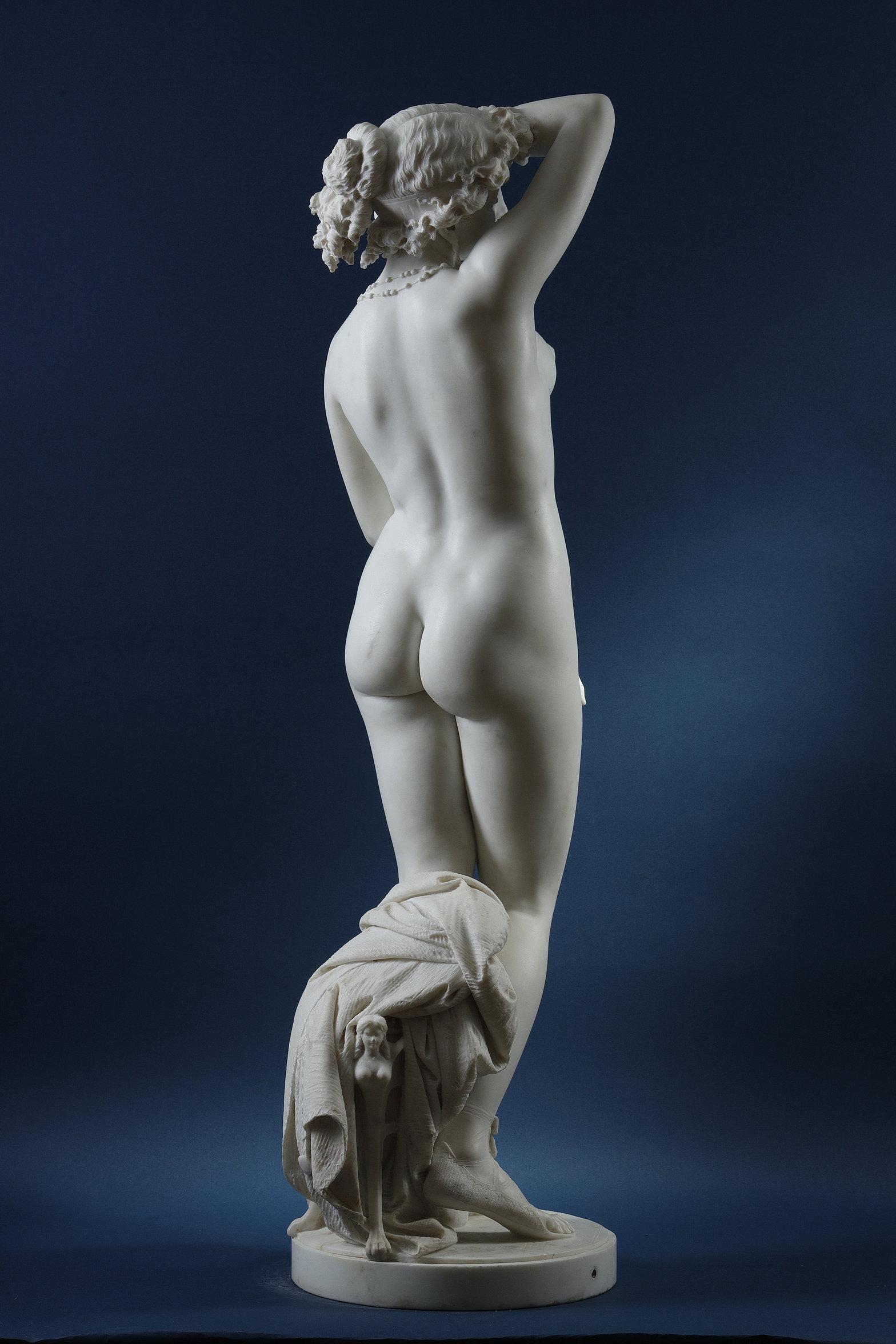
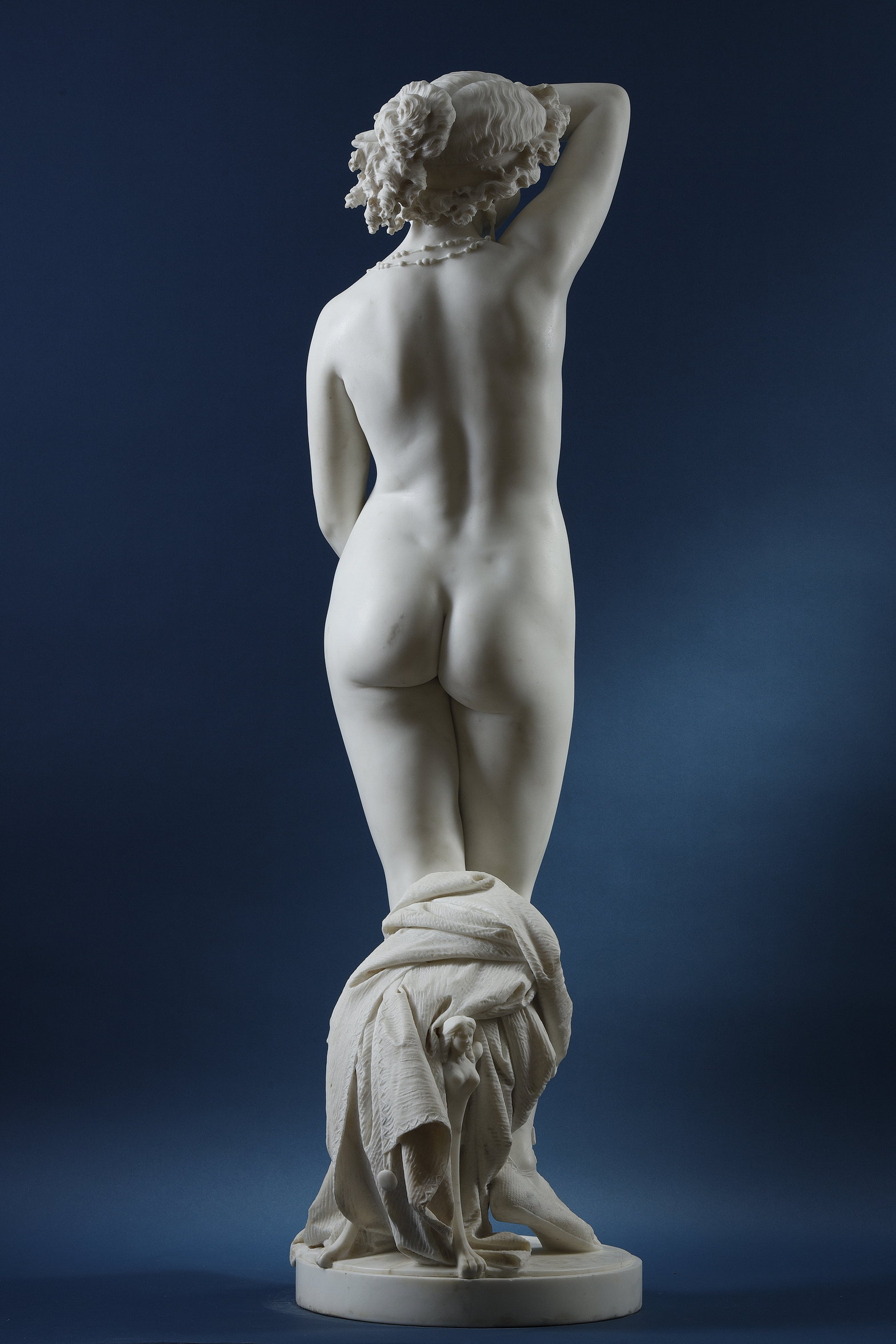
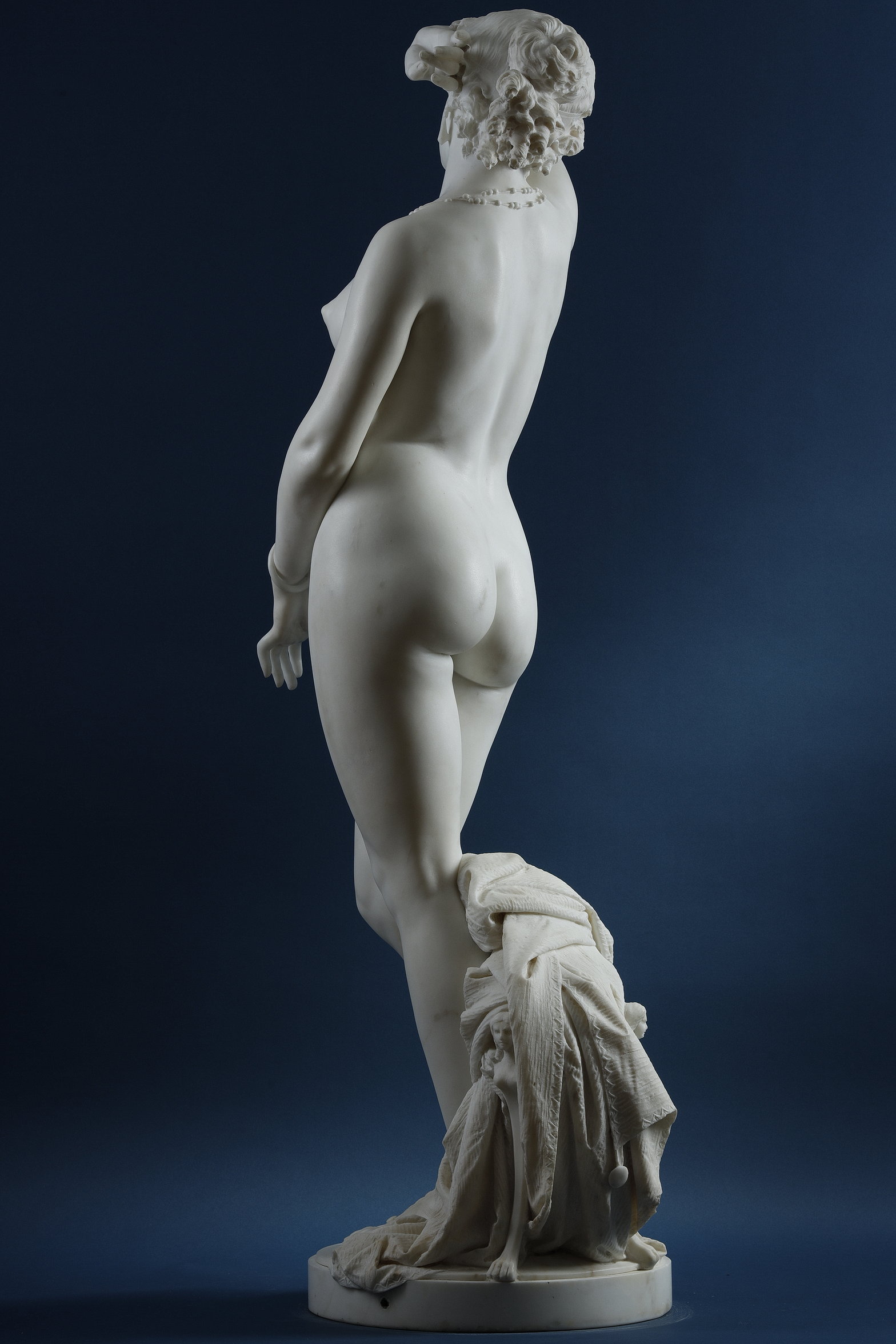
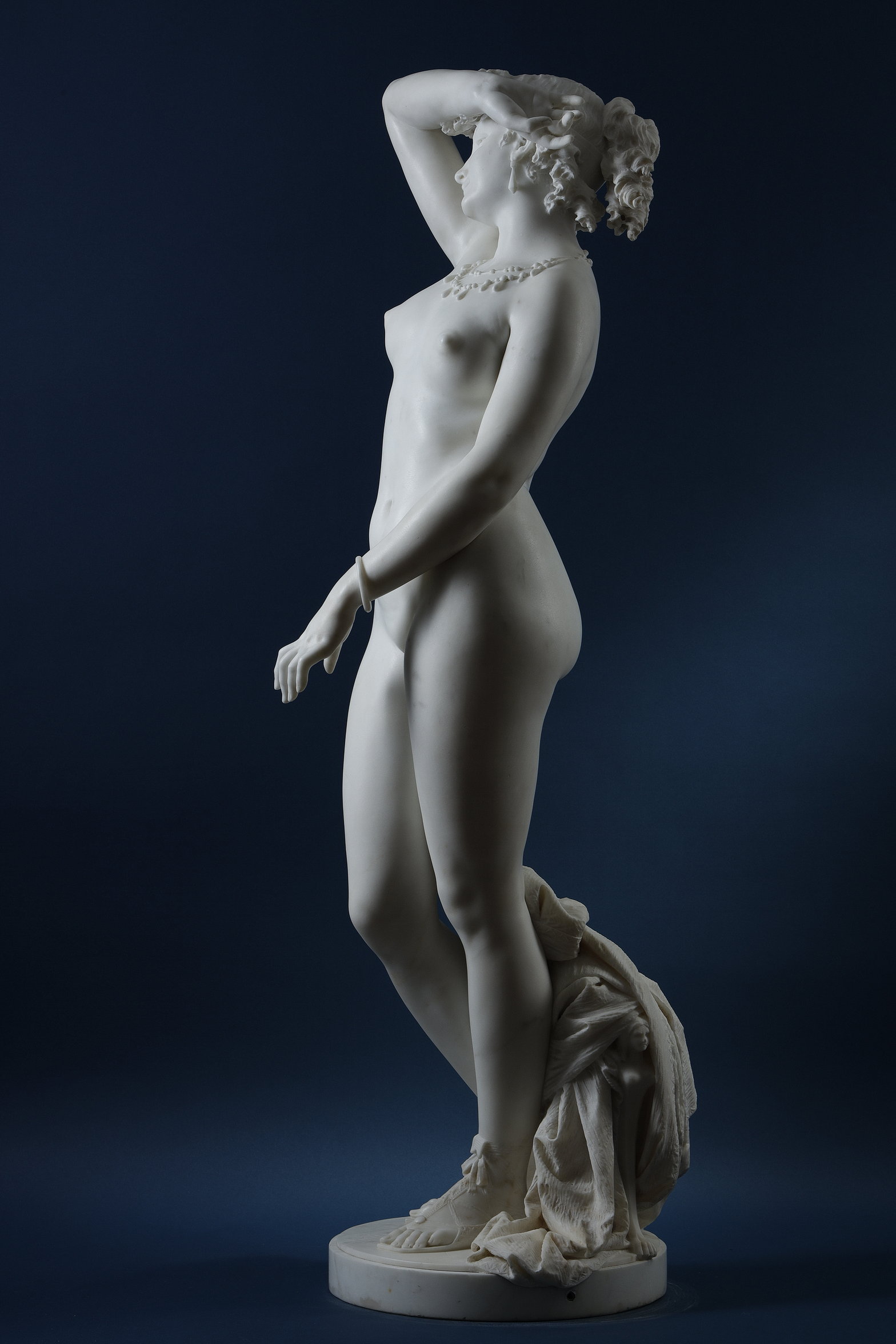
Francesco Barzaghi’s sculpture draws explicit inspiration from the painting Phryne before the Areopagus by Jean-Léon Gérôme, completed in 1861, a work that made a considerable impact. The scene depicted is drawn from one of Antiquity’s most celebrated anecdotes: the trial of Phryne, the famous Athenian hetaira of the fourth century BC. According to legend, when she faced death on charges of impiety, her defender Hyperides revealed her beauty before the jury, which, struck with admiration, acquitted her.
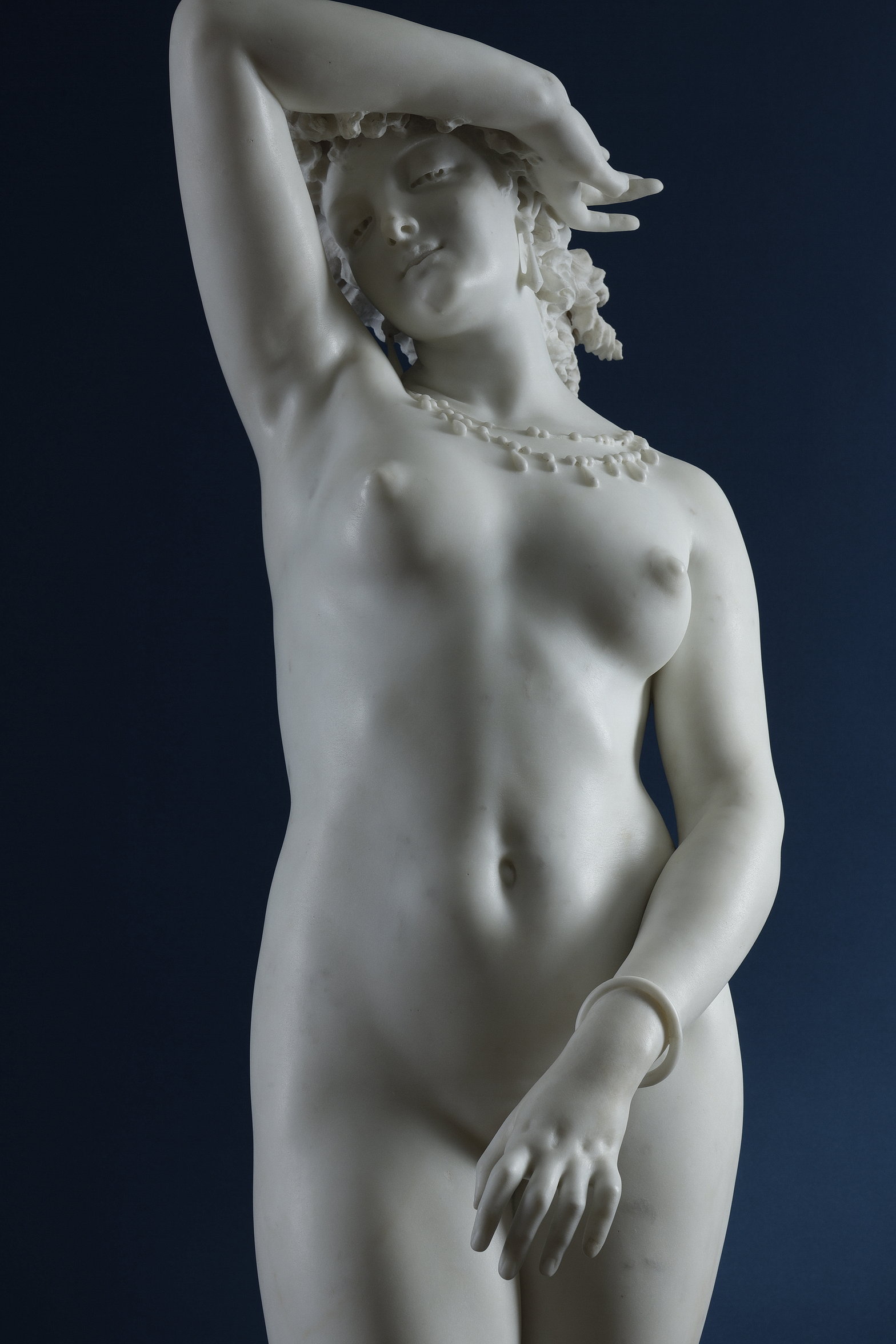
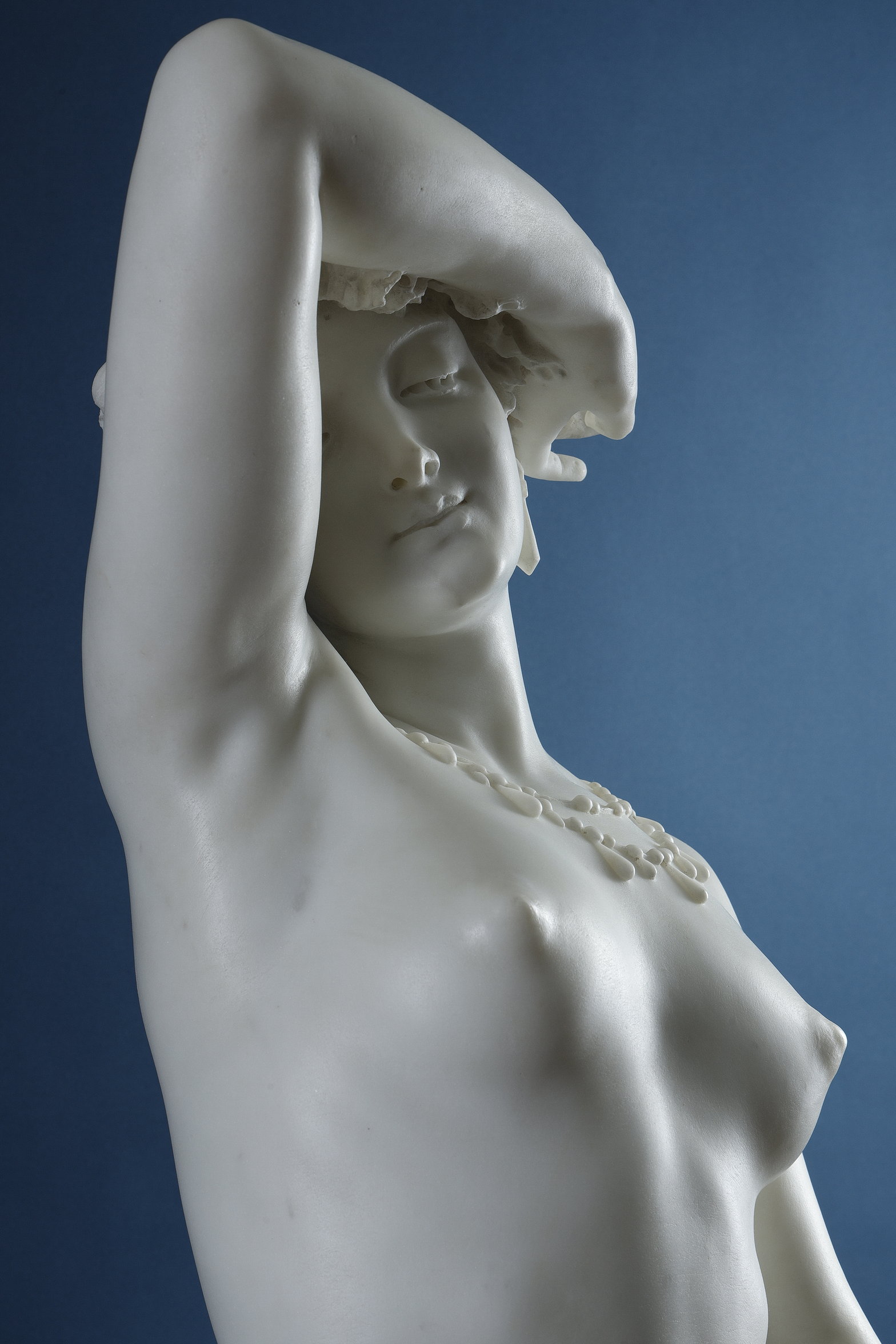
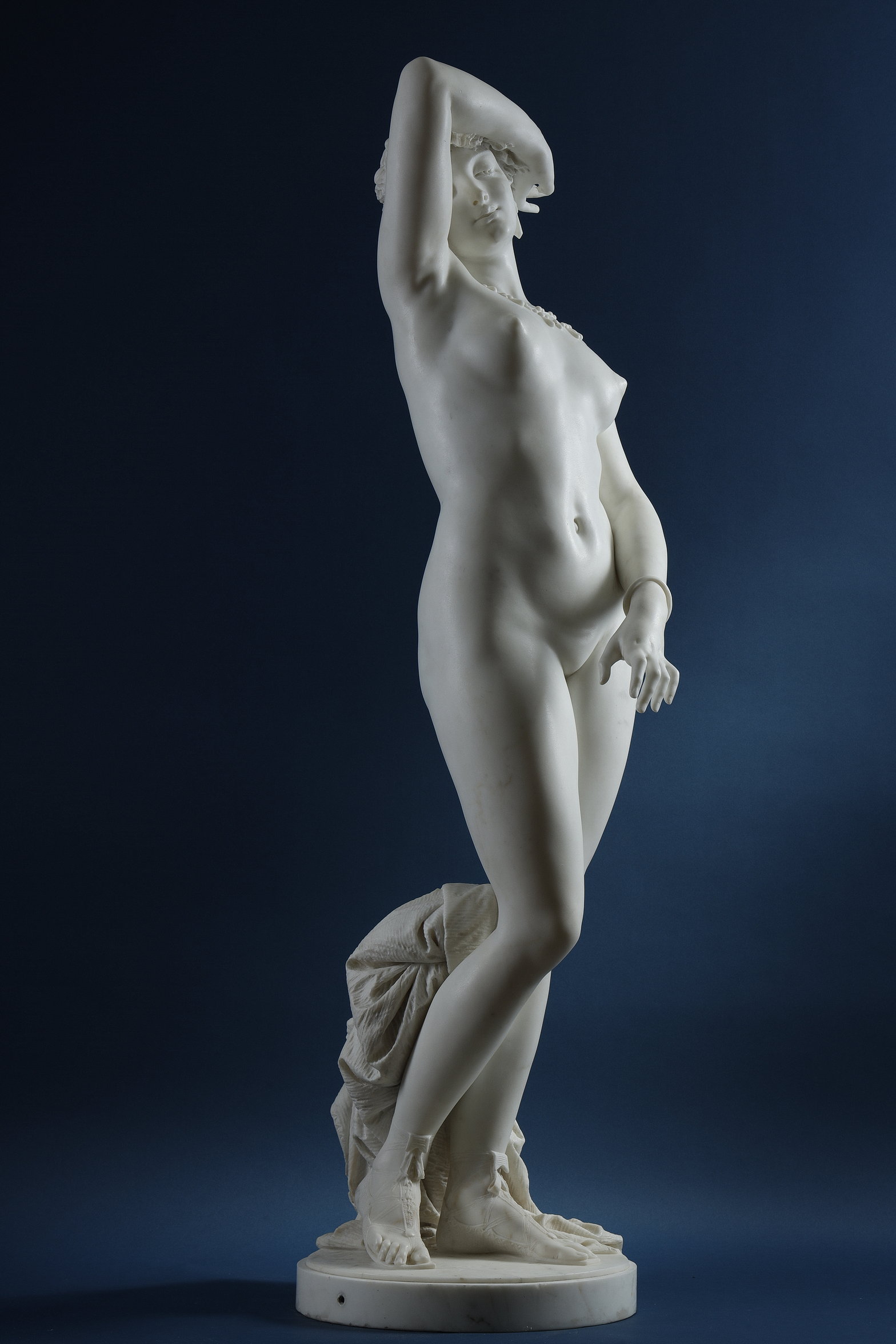
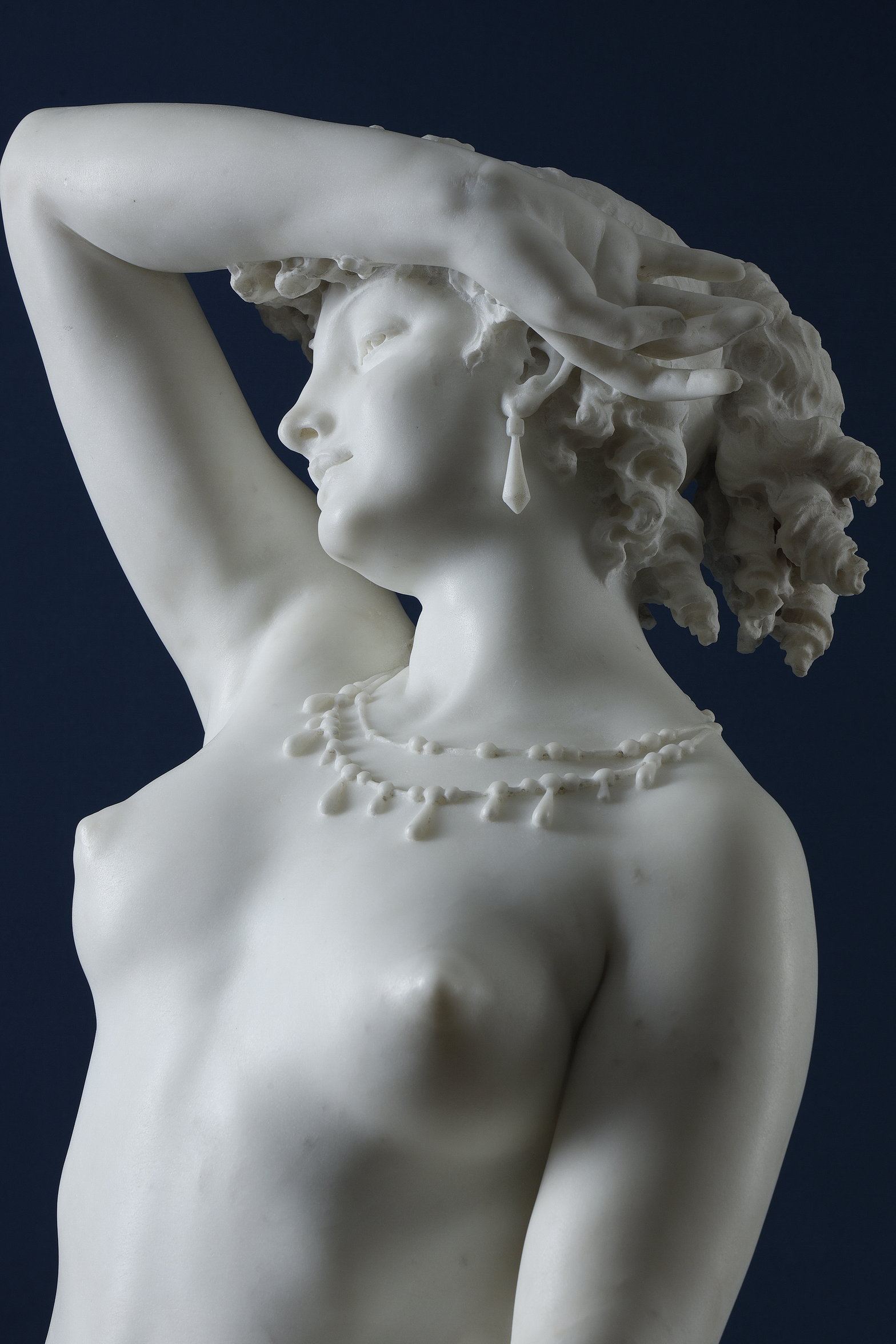
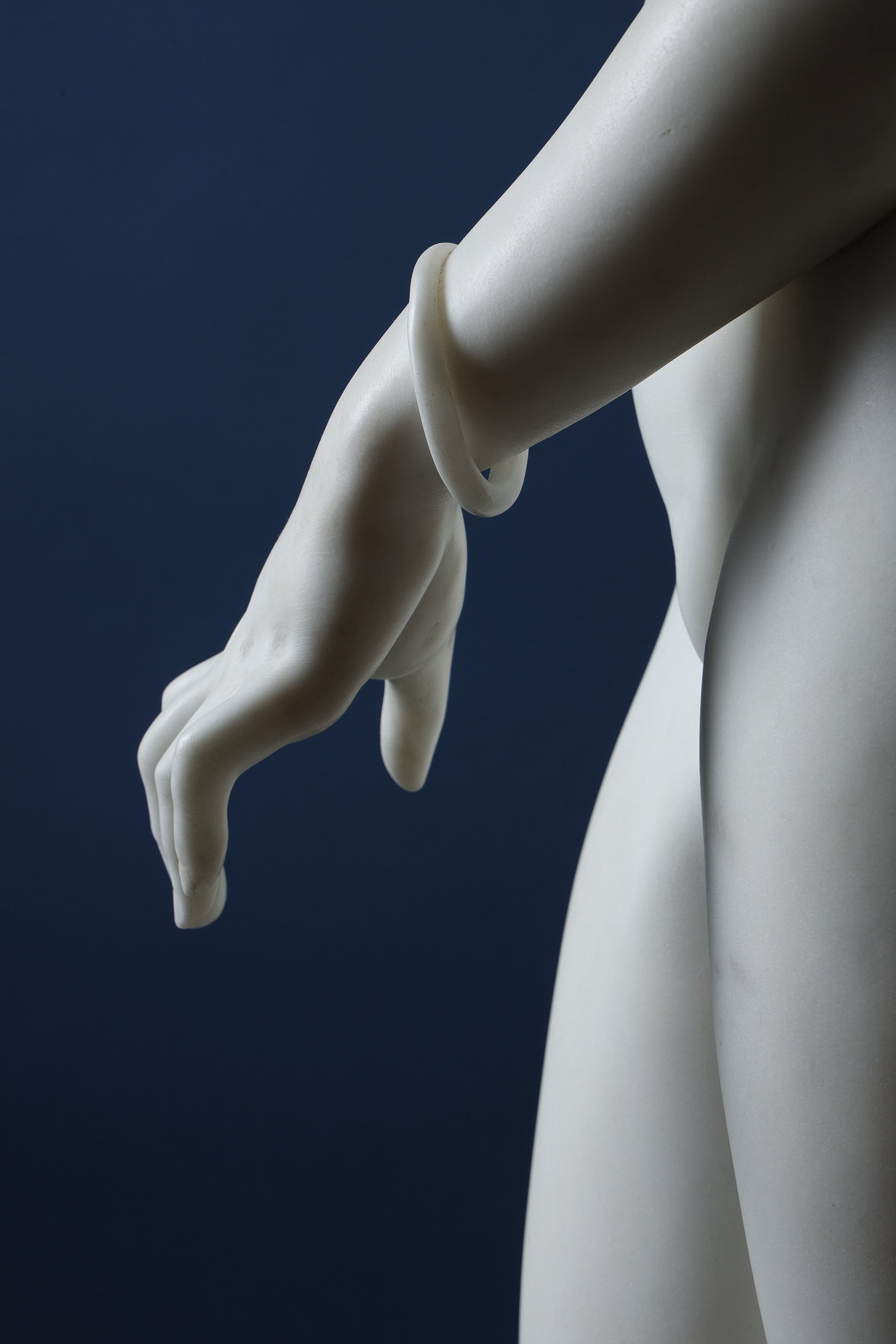
Barzaghi chose to represent the decisive moment: Phryne stands before her judges, her garment partially removed, her gaze at once vulnerable and defiant. The composition captures the ambiguity of the scene, the boundary between shame and triumph, exposure and power. The marble is worked with extraordinary delicacy: the translucent quality of the stone conveys the warmth of flesh, while the drapery falling at her feet attests to Barzaghi’s mastery in rendering texture and movement. The face, serene yet intense, reflects the psychological complexity of the subject.
This theme, widely explored in nineteenth-century sculpture and painting, embodied contemporary debates around feminine beauty, morality, and the power of art. Barzaghi’s interpretation stands as one of the most refined treatments of this subject in Italian sculpture of the period.
A monumental version of approximately 170 cm is documented by an engraving published in L’Esposizione Universale del 1867 illustrata, corresponding to the work presented at the Paris Universal Exhibition of 1867. This version is distinguished by a specific treatment of the jewelry, whose typology differs noticeably from that adopted in later versions.
Another version of the same dimensions, now held at the Galleria d’Arte Moderna in Milan (acquired following its presentation at the Second National Exhibition of Milan in 1872), features a different ornamental system: the jewelry corresponds to a stabilized typology also found in the versions exhibited in Vienna in 1873 and at the Promotrice in Genoa in 1878.
A reduced version of approximately 110 cm is preserved at the Museo del Castello d’Albertis in Genoa, demonstrating that the model also circulated in more intimate formats.
According to documentation provided by the Galleria d’Arte Moderna in Genoa, the version held by that museum, which would therefore share the same ornamental characteristics as our version, dates from 1865, the year of the exhibition held in Porto.
Contemporary critical reception is telling. The Gazette des Beaux-Arts explicitly mentions Francesco Barzaghi’s Phryne among the major Italian works presented to the French public, highlighting its power of attraction and its central place in the aesthetic debates of the time. In L’Art universel (1873), the sculpture is cited among the rare works capable of reconciling formal elegance, unabashed sensuality, and artistic dignity, in contrast to productions considered artificial or provocative.
Literature
- Panzetta, Alfonso. Nuovo Dizionario degli Scultori Italiani dell’Ottocento e del Primo Novecento, A–L. Torino : AdArte, 2003.
- Cucciniello, Omar. « Francesco Barzaghi, Frine (Frine denudata davanti ai giudici) », dans Arte in mostra – La Scuola di Milano e le grandi esposizioni internazionali, p. 142–143.
- Larousse, Pierre. Grand Dictionnaire universel du XIXe siècle. Paris : Administration du Grand Dictionnaire Universel, 1866–1890, t. 17, Suppl. 2.
- Rondani, Alberto. Scritti d’arte. Parme, 1874.Bibliothèque nationale centrale de Florence. Domaine public.
- Exposition universelle de 1867 à Paris : Catalogue général. Première partie, contenant les œuvres d’art. Paris : E. Dentu, 1867.
- L’Esposizione universale del 1867 illustrata. Milano : Edoardo Sonzogno, 1867, vol. 2. Getty Research Institute.
- Esposizione Nazionale di Belle Arti, Brera 1871, cat. n° 365.
- Seconda Esposizione Nazionale di Belle Arti, Milano, 1872. Regia Accademia di Brera.
- Wien Museum, Vienna. Phryne, Skulptur von Francesco Barzaghi, Mailand (Nr. 599), Weltausstellung 1873. Photograph. Wien Museum Collection.
- Fra quadri e statue : stenna-ricoro della Seconda Esposizione nazionale di belle art : lettere al pungolo, Milan, Fratelli Treves, 1873
- Exposition Universelle de 1876 à Philadelphie : Catalogue officiel des oeuvres d’art exposées.
- Gazette des Beaux-Arts : courrier européen de l’art et de la curiosité. Paris, 1er juillet 1873.https://catalogue.bnf.fr/ark:/12148/cb343486585
- Revue de Paris, dir. Jean du Boys. 1er novembre 1867.https://catalogue.bnf.fr/ark:/12148/cb32857931h
- Revue Contemporaine, dir. Alphonse de Calonne. 1er mai 1867.https://catalogue.bnf.fr/ark:/12148/cb344617319
- L’Art Universel, dir. Camille Lemonnier. Bruxelles, 1er février 1873.https://catalogue.bnf.fr/ark:/12148/cb327026914
- Le Temps, Paris, 19 octobre 1881.https://catalogue.bnf.fr/ark:/12148/cb34431794k
- Le Gaulois : littéraire et politique, Paris, 28 novembre 1874.https://catalogue.bnf.fr/ark:/12148/cb32779904b
- Musatti, Eugenio. I Monumenti di Venezia, guida sinottica. Venezia : Ongania, 1893. https://catalogue.bnf.fr/ark:/12148/cb309988645
the ARTIST
Francesco Barzaghi
1839 – 1892
Born in Milan in 1839, Francesco Barzaghi was one of the leading Lombard sculptors of the second half of the 19th century. Trained at the Accademia di Brera and in the studio of Vincenzo Vela, he combined expressive realism with strong technical discipline.
similar works