alphons joseph strymans · (1866–1959)
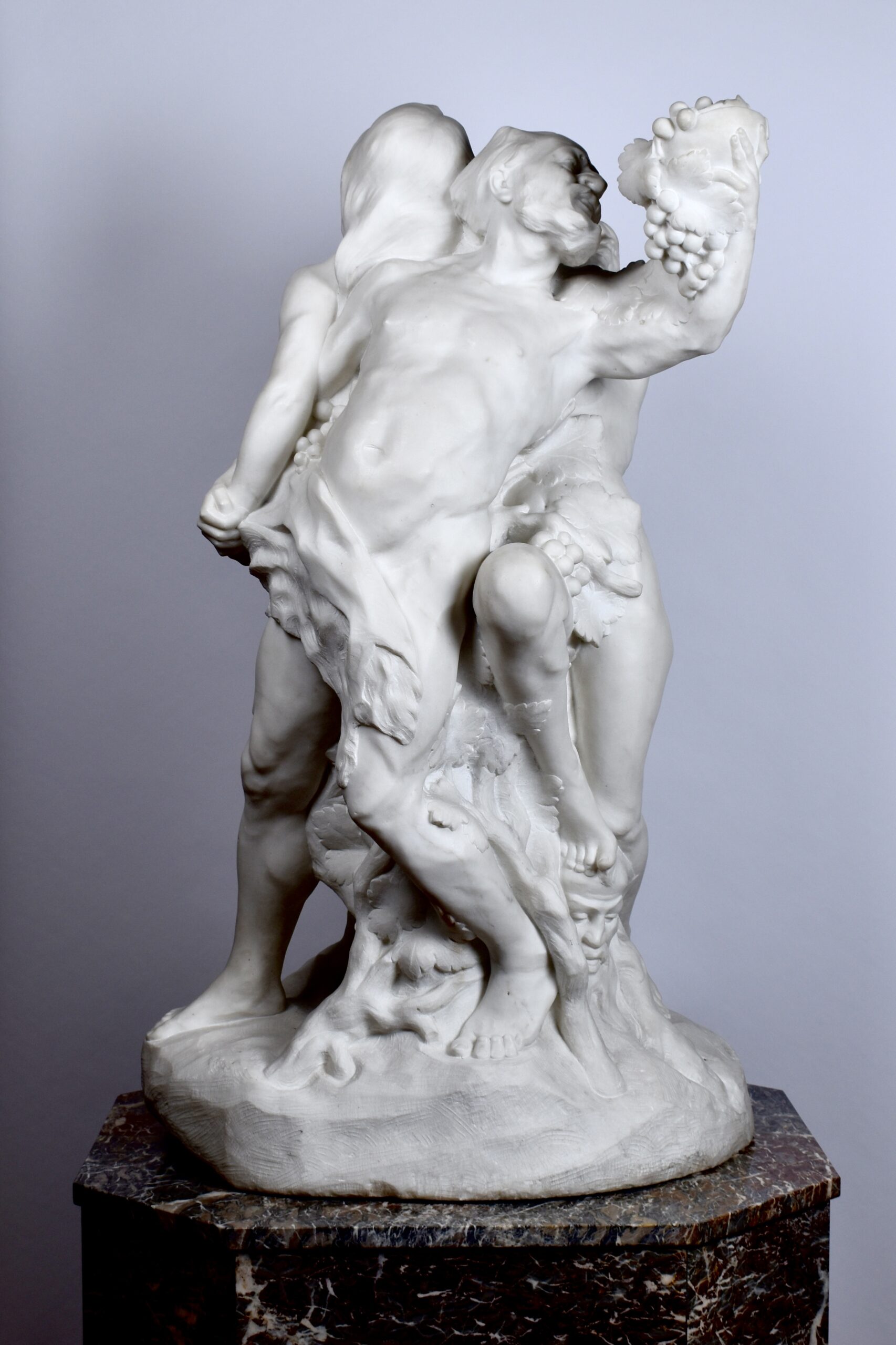
The Wine
technical sheet
| ARTIST | Alphons Joseph Strymans |
| DATE | 1901 |
| material | White Carrara marble |
| DIMENSIONS | Height : 130 cm |
| Signature | A. Jef Strymans 1901 |
| PROVENANCE | Tervueren Exhibition, 1906 • Artimo Fine Art Gallery, 2001 • Private Collection, 2004 • Artimo Fine Art Gallery, 2021 |
| CONSERVATION | Private Collection • Belgium |
about the work
Masterfully executed in white Carrara marble, this figurative composition reveals three human figures caught in dynamic interaction. The anatomical precision and refined modelling attest to the exceptional talent of the sculptor Alphons Joseph Strymans.
The trio, two women and a man, all nude, intertwine in a choreography evoking an ecstatic dance. Each holds clusters of grapes rendered with remarkable precision, an evident symbol of winemaking. It is particularly striking that one of the women appears to lean upon, or even dominate, a man lying on the ground, his face serving as her point of support. This composition, at once graceful and intense, eloquently illustrates the effects of wine upon the soul and upon human relations.
The silhouettes merge harmoniously with vegetal motifs evoking the vine, suggesting an intimate union of man and nature in their shared inebriation. The work poetically evokes the idea that man and nature share a common essence, a profound and shared origin.
the ARTIST
Alphons Joseph Strymans
Turnhout, 1866 — 1959, Antwerp
A cabinetmaker, draughtsman and, above all, sculptor, Strymans trained at the art school of Turnhout, refining his craft alongside his father, a renowned cabinetmaker specialising in church furniture, which gave him an exceptional command of both wood and stone. He continued his studies at the Antwerp Academy and then at the Higher Institute of Fine Arts in Brussels under Thomas Vinçotte.
From 1898 to 1935 he taught drawing at the art school in Berchem, collaborating with eminent sculptors such as Frans Joris, Jules Weyns and Josué Dupon. His repertoire was vast, encompassing Art Nouveau ornaments and works in bronze, ivory and marble. Several institutions preserve his creations, including the Museum of Central Africa in Tervueren, the Dinant Museum and the Antwerp Museum.