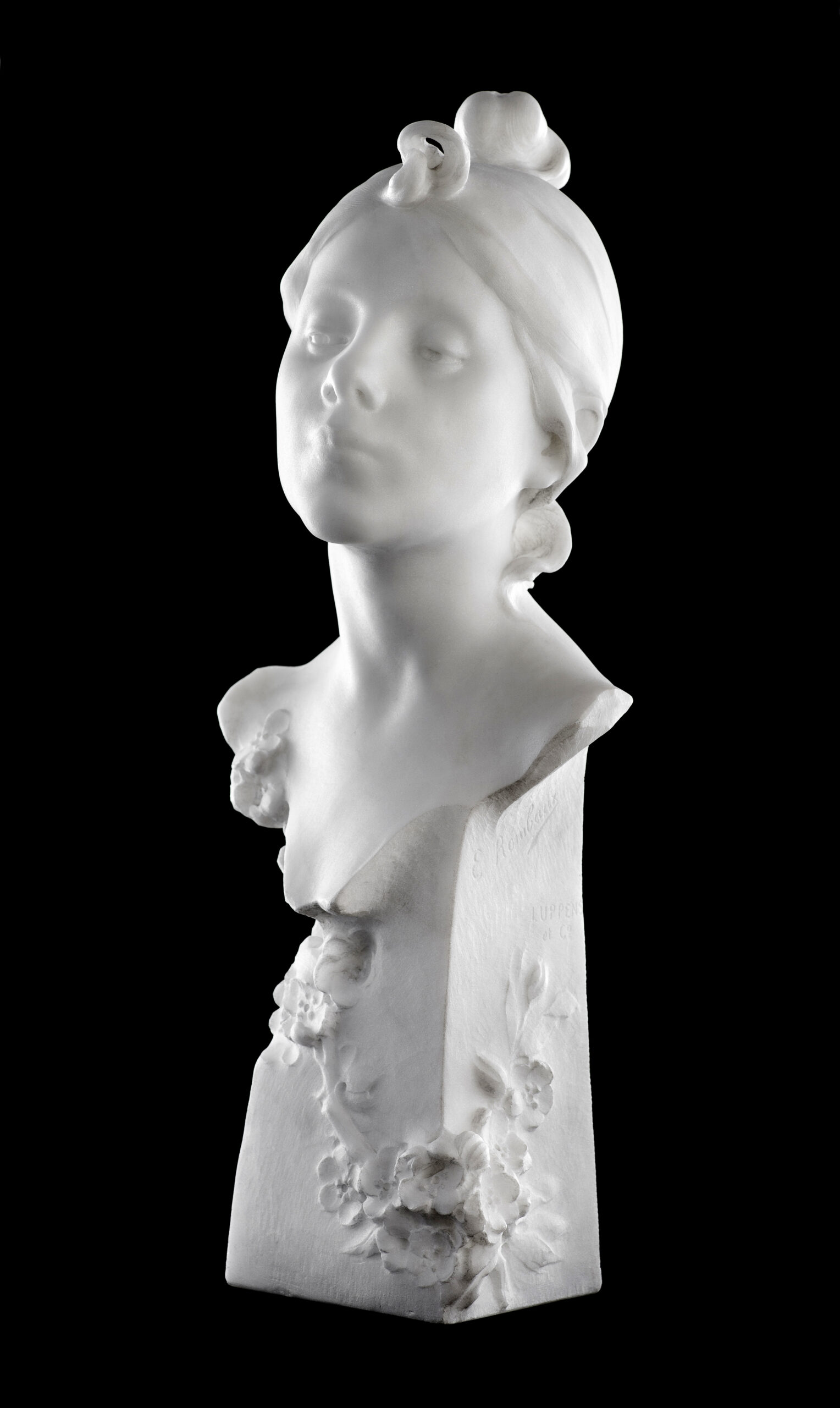
égide rombaux · (1865–1942)
Églantine
technical sheet
| ARTIST | Égide Rombaux |
| DATE | ca. 1900 |
| MATerial | White Carrara marble |
| DIMENSIONS | 56 x 14 x 12 cm |
| Signature | E. Rombaux |
| PROVENANCE | |
| CONSERVATION | Private Collection |
About the work
Although the name carved on the front of the sculpture is “Eglantine,” that of a flower, the work in fact portrays the artist’s sister, Adèle. This achievement by Égide Rombaux is without reservation among the highlights of his oeuvre and at the same time one of the icons of Belgian Art Nouveau. Everything about it is infused with spirit and offers an ode to what those aiming for the purest refinement can only dream of.
All the abilities upon which Rombaux’s work rests bring this bust to life, considerations of style remaining wholly secondary to the artist. Disarming in its gentleness, the sculpture welcomes us as a symbol of the first, tender pleasures of life.
Carved in white Carrara marble, the portrait testifies to the sculptor’s virtuosity. Two similar but less elaborate busts are held in the Royal Museums of Fine Arts of Belgium in Brussels, underscoring the importance of this subject within his career.
the ARTIST
Égide rombaux
Schaerbeek, 1865 — 1942, Uccle