pieter puyenbroeck · (1804–1884)
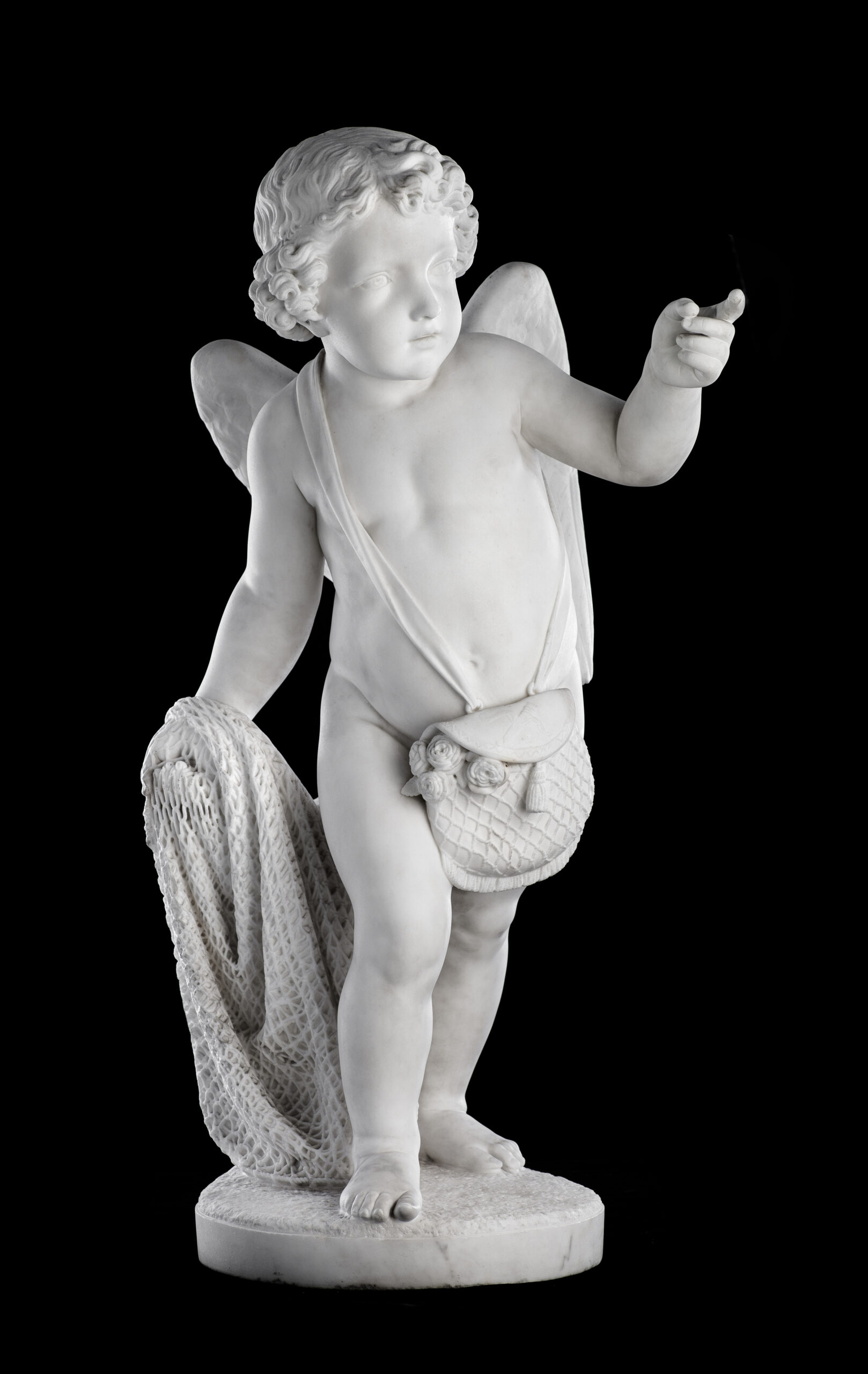
Cupid as a Fisherman
technical sheet
| ARTIST | Pieter Puyenbroeck |
| DATE | ca. 1870 |
| material | White Carrara marble |
| DIMENSIONS | 84 x 36 x 50 cm |
| Signature | P. Puyenbroeck |
| PROVENANCE | |
| CONSERVATION | Private Collection • Belgium |
ABOUT THE WORK
That which astounding craftsmanship sets out to do with a large block of costly marble is demonstrated in this highly original Cupid. He does not hunt for willing victims with a bow and arrow, but, as a fisherman, is ready to cast his net. Flowers spill seductively from his knapsack and, the sweet-looking boy that he is, Cupid is perfectly capable of eliciting interest himself.
Our attention is immediately drawn to the rendition of the fishing net that hangs down. Such a tour de force demands the height of a sculptor’s technical ability, both in the fine detailing and in the suggestion of volume and weight. Yet Puyenbroeck did not leave it at that: through the net he has managed faintly to reveal the fingers that stretch the meshes — the pinnacle of realism and daring.
One might overlook the remaining qualities at this sight: the outstretched left arm, the excellently rendered anatomy as a whole, the calm dynamics and the overall posture of this winged child, which unite apparent simplicity with the utmost refinement.
The ARTIST
Pieter Puyenbroeck
Leuven, 1804 — 1884, Schaerbeek
Pieter Puyenbroeck was an accomplished sculptor with a didactic inclination. After training with the elder G. L. Godecharle, whom he greatly admired, he opened his own large studio in 1840, where he instructed young artists in a practice-based manner; his influence on Auguste Fraikin was essential. As early as 1830, his sculpture Summer, shown at the Salon of Brussels, was immediately bought by the Royal Park.
The centre of gravity of his oeuvre lies in and on religious buildings: reliefs and statues of saints, and the Stations of the Cross in Saint Gudule Cathedral, unanimously regarded as his finest work, together with the Three Kings for its façade. He also produced numerous busts and secular sculptures for the town halls of Leuven and Brussels.