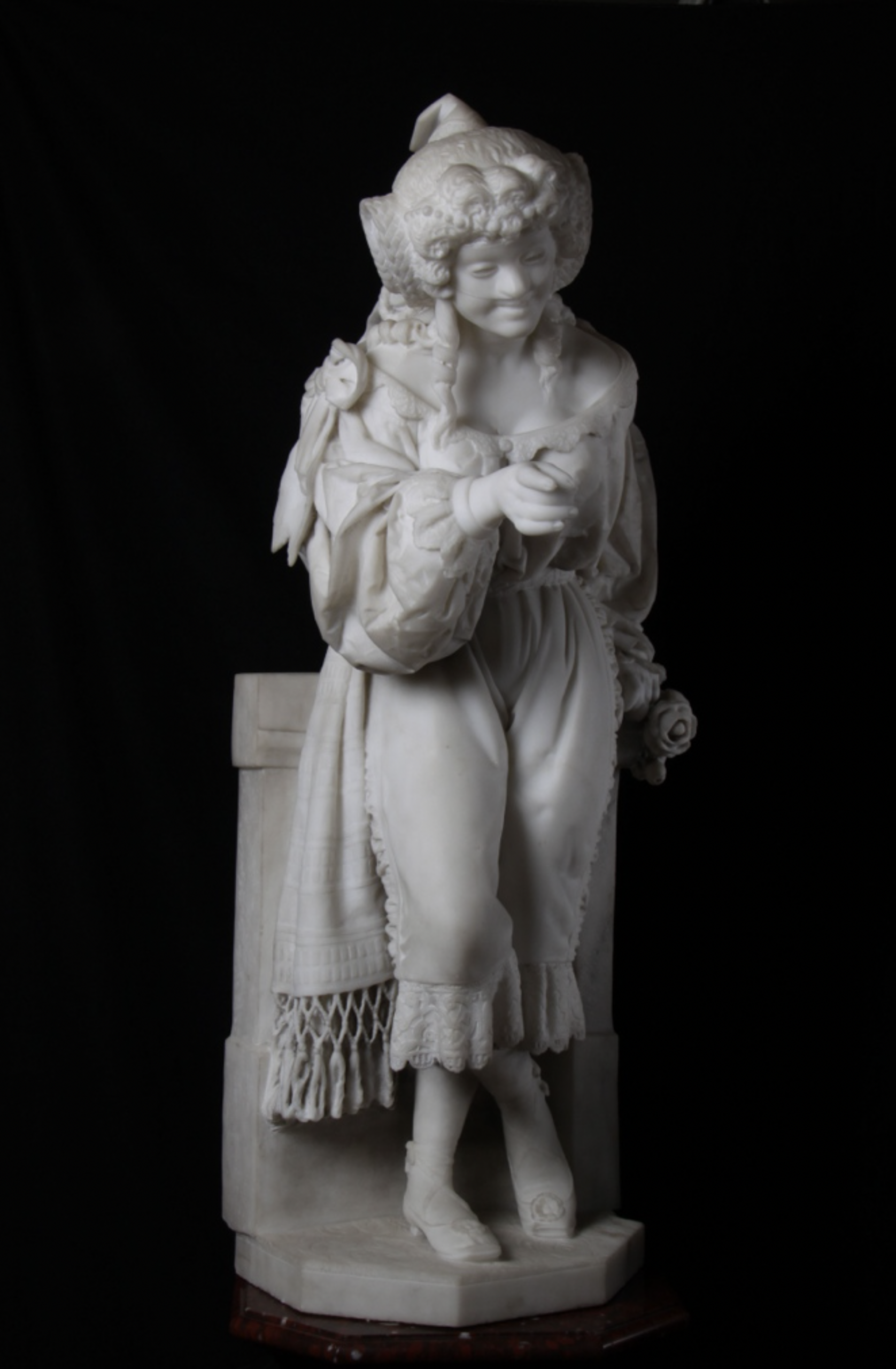
emilio zocchi · (1835–1913)
Lady with a Mask
TEchical sheet
| ARTIST | Emilio Zocchi |
| DATE | Late 19th century |
| material | White Carrara marble • column in red and black marble |
| DIMENSIONS | Height : 90 cm • column height : 111 cm |
| Signature | E. Zocchi F. Florence |
| PROVENANCE | |
| CONSERVATION | Private collection |
about the work
An exceptionally fine and rare nineteenth-century sculpture, this work depicts a woman in disguise, hidden behind a Venetian mask and dressed in the Venetian manner. Its subject, all play of seduction and mystery, evokes the world of carnival and the masked balls so beloved of the period.
The precision of the carving testifies to Emilio Zocchi’s exceptional mastery. One need only look at the hem of the scarf, the bow set upon the right shoulder, or the roses the woman holds in her left hand to understand why his works are found in the world’s leading museums, such as the Palazzo Pitti in Florence, the Gallery of Modern Art in Rome, and the Sydney Museum.
The white marble, patiently worked, yields here to the smallest details of the costume; it rests upon a column of red and black marble whose deep tones set off the brilliance of the figure. Together they form an object of great refinement, fully representative of the virtuosity of Italian sculptors in the second half of the century.
the artist
emilio zocchi
Florence, 1835 — 1913
Emilio Zocchi perfectly embodies the talent of the Italian sculptors of his time. Born in Florence in March 1835, he entered at the age of nine the studio of Girolamo Torrini, then that of Aristodemo Costoli, before completing his training under the renowned Giovanni Duprè at the Accademia di Belle Arti, where he later became a tutor. His country recognised his gifts by honouring him as an Officer of the Order of the Crown of Italy, a highly prestigious title.
In 1862 he modelled a statue of the young Michelangelo at work. Zocchi also contributed to many Italian monuments: in 1890 he executed the model for the famous bronze of “Vittorio Emanuele II” in Florence, as well as the façade bas-relief of the Basilica of Santa Croce.